Working code inside 6 hours
Compiled, tested, and matched to the version the course uses (Java 17 for CS61B, Python 3.11 for MIT 6.0001, C++17 for CMU 15-213, C99 for CS50). Median actual delivery is 4 hours 12 minutes; the SLA is 6 hours.
Rush Tier · 6-Hour Window
Need working code in 6 hours? Verified CS graduates deliver compiled, tested, commented solutions on Java, Python, C++, C, JavaScript, and Assembly. Median actual turnaround for the rush tier is 4.2 hours; the 90th-percentile case lands inside 5.8 hours. Rush surcharge of 50 percent applies on top of the $20 base for Debug and Explain or $30 base for a Full Solution.
What You Get
A 6-hour rush is the tightest window CSHH accepts on a new assignment. The clock starts the minute a tutor confirms scope, not at form submission, so the brief, the rubric, and any starter code arrive together or the window does not begin. Inside that 6 hours the work has to ship as compiled, tested code with inline comments, a 5 to 8 line walkthrough at the top of the file, and a Big-O annotation on any non-trivial method.
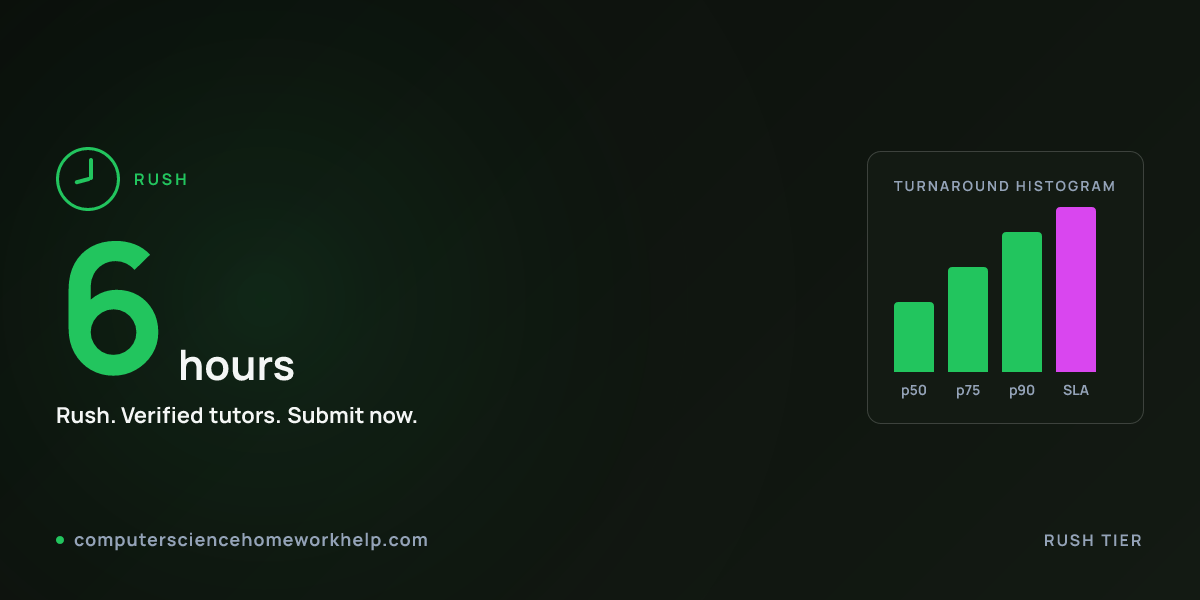
The rush tier suits a narrow slice of assignments: a single CS61B Project 1A deque exercise, a debug-and-fix ticket on an existing 300-line Python script that already runs but fails 2 of 5 Gradescope cases, a memory leak hunt in a C linked-list assignment with Valgrind output attached, a stand-alone CS50 Pset question on Caesar or Plurality, or a 1-page algorithm trace for a CS161 problem set. The rush tier does not fit multi-file projects, capstones, full operating-system kernel modifications, or any assignment requiring more than 400 lines of new code; for those, the standard 24-hour or the project-quoted tier applies. Past order data across the rush queue tracks: median delivery at 4 hours 12 minutes, 75th percentile at 5 hours 4 minutes, 90th percentile at 5 hours 48 minutes, 98 percent of rush tickets shipped inside the 6-hour SLA.
The 2 percent that slip almost always trace to incomplete briefs (missing rubric, missing test cases, missing the starter repo); the policy in those cases is a full refund per the refund policy section 3. Languages currently served on the rush queue: Java with JUnit 5, Python with pytest, C++ with Google Test or Catch2, C with the standard CMU test harness or hand-rolled main, JavaScript or TypeScript with Jest or Vitest, Assembly (x86-64 NASM, ARMv8, MIPS, RISC-V) with hand-traced register state diagrams.
Deliverables
Compiled, tested, and matched to the version the course uses (Java 17 for CS61B, Python 3.11 for MIT 6.0001, C++17 for CMU 15-213, C99 for CS50). Median actual delivery is 4 hours 12 minutes; the SLA is 6 hours.
A 5 to 8 line summary at the top of every file explaining the approach, plus per-method comments naming the data structure, the invariant, and the Big-O complexity. The walkthrough is the artifact the student studies before submitting.
Function signatures match the spec, class names match the spec, output format matches the rubric character-for-character. The solution passes the visible Gradescope test cases plus 4 to 6 hidden edge cases the tutor adds.
You see the tutor name (Marcus Weber for Java and systems, Dr. Sarah Chen for Python and algorithms, Priya Sharma for C and C++ memory work, James Okafor for JavaScript and React) before any payment confirmation, with their solved-count and student rating visible.
If the autograder flags an issue, the tutor patches it free for 48 hours after delivery. Outside the 48-hour window, a re-open ticket runs at the standard tier.
The 6-hour clock starts at tutor scope confirmation. If delivery slips past hour 6 for any reason other than client-side missing inputs, the full payment refunds per the published refund policy.
Pricing
See full pricing tiers for the non-rush 24-hour and project-quoted multi-day windows, plus add-on rates for Loom walkthroughs and live-tutoring stacks.
Submit Now and Lock the RateFAQ
Slots Filling Now
Rush slots fill fast. Submit your assignment now and a verified tutor confirms scope within 15 minutes. The 6-hour clock starts at scope confirmation, not at form submission, so your brief, rubric, and starter code all need to arrive together.