← All Libraries

Python data analysis library

pandas Homework Help

DataFrame operations, groupby, merge, time series, and the SettingWithCopyWarning explained for university data science coursework. The top failure mode in data wrangling assignments is chained indexing that triggers SettingWithCopyWarning then silently fails to mutate, the bug our tutors patch with explicit .loc assignment. Verified CS graduates from Georgia Tech, Purdue, and BITS Pilani, starting at $20 per task, 12-hour average turnaround.

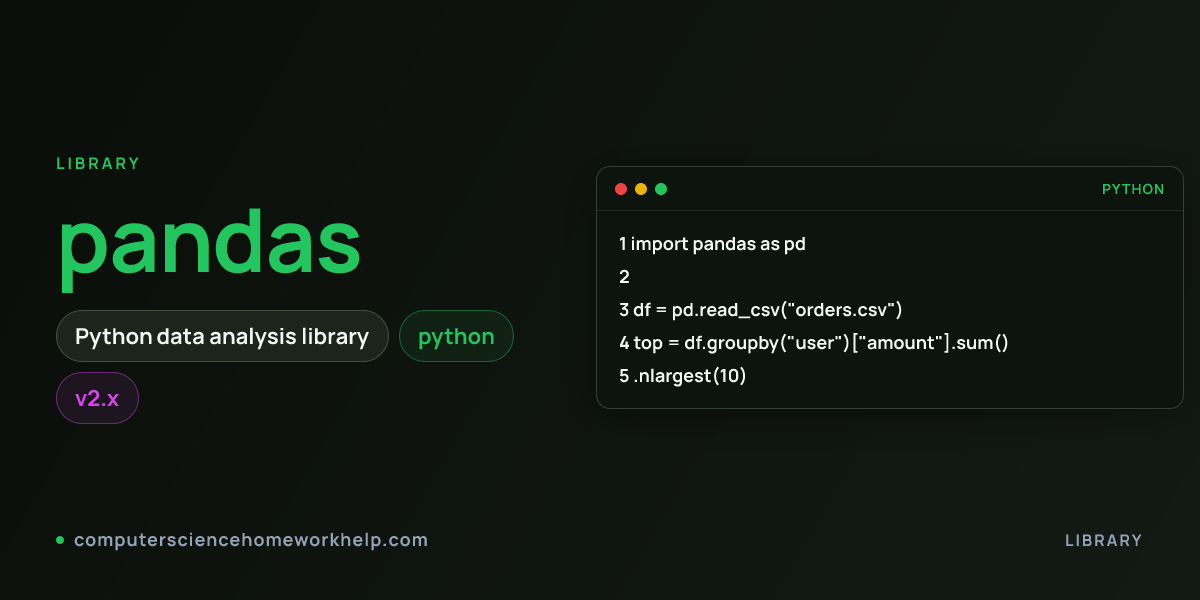
pandas hero visual showing the library name and an idiomatic code snippet
2.x Version
Python Primary Language
7 Common Project Types
9 Answered FAQs

About

About pandas

pandas is a Python data analysis library built on NumPy that provides the DataFrame and Series structures for labeled, tabular, and time-series data. The 2.x release line introduced PyArrow-backed string and extension dtypes, copy-on-write semantics (opt-in via pd.options.mode.copy_on_write=True, becoming default in 3.0), and significant performance improvements for groupby and merge operations. Students meet pandas in data science courses (CS109 Harvard, CS246 Stanford Mining Massive Datasets, 6.S897 MIT Machine Learning for Healthcare), in any course that grades exploratory data analysis or feature engineering, and in Kaggle-style competition assignments.

The library splits into IO (read_csv, read_parquet, read_sql, read_json, read_excel), data manipulation (loc and iloc indexing, query, assign, pipe), aggregation (groupby, agg, transform, apply), reshaping (pivot, pivot_table, melt, stack, unstack), merging (merge, join, concat), time series (date_range, resample, rolling, ewm, time zone localization and conversion), and visualization (DataFrame.plot built on matplotlib, with seaborn as the typical extension). CSHH tutors deliver DataFrame pipelines using method chains (.pipe for custom functions), .loc and .iloc for explicit indexing (avoiding the chained indexing that triggers SettingWithCopyWarning), groupby with agg passing a dict of column-to-function mappings for multi-output aggregation, merges that explicitly state how (inner, left, right, outer) and on (column name or index), and the .copy() pattern when a slice will be modified independently of the source.
Coursework

Common pandas Project Types

Exploratory data analysis on a CSV dataset

pd.read_csv with proper dtypes (avoid string for numeric columns to save memory), .info() and .describe() for the initial summary, .isna().sum() for missing-value audit, .value_counts() for categorical distributions, groupby aggregations for relationships, and matplotlib or seaborn for visualization. Common assignments in CS109 use the Titanic, Iris, or California Housing datasets.

Time series analysis with resampling

pd.read_csv with parse_dates and index_col on a timestamp column, .asfreq("D") to enforce daily frequency with NaN for missing dates, .resample("M").mean() for monthly aggregation, .rolling(window=7).mean() for moving averages, .ewm(span=30).mean() for exponential weighted, and seasonal decomposition via statsmodels for trend and seasonality extraction.

Feature engineering for ML pipeline

One-hot encoding via pd.get_dummies or sklearn.preprocessing.OneHotEncoder, log transformation for skewed numeric features (np.log1p), categorical encoding (target encoding, leave-one-out, frequency encoding), interaction features (df["a_times_b"] = df["a"] * df["b"]), datetime features (year, month, day_of_week, is_weekend), and binning via pd.cut or pd.qcut.

Join multiple tables for a business report

pd.merge with how="inner" or "left", on=["customer_id", "date"] for composite keys, validate="one_to_many" to assert the expected cardinality, indicator=True to flag rows that did not match on either side, and suffixes=("_a", "_b") for overlapping column names. Tutors include the assertion that the merged row count matches expectation, catching silent join bugs early.

Pivot table for a sales dashboard

pd.pivot_table with index, columns, values, aggfunc (or dict of aggfuncs per column), margins=True for grand totals, fill_value=0 for missing cells, and dropna=False to keep the full grid. Tutors include the .melt counterpart that reverses pivot, useful for switching between wide and long formats.

Database export pipeline

pd.read_sql_query against a PostgreSQL or MySQL connection (sqlalchemy.create_engine), chunked reading with chunksize for tables too large to fit in memory, in-memory transformation, .to_parquet for the output (10x smaller than CSV, preserves dtypes including categoricals and datetime). Tutors include the dtype mapping that prevents int64 silently becoming float64 when NaN is present.

Text data cleaning at scale

Series.str accessor for vectorized string operations (lower, strip, replace, contains, split, extract with regex), pd.api.types.is_string_dtype guards, conversion to the new PyArrow-backed string dtype for 2x speed-up, and apply with a custom function for operations not in the .str API. Tutors include the .str.cat versus + comparison.

Debugging

pandas Debugging Patterns We Teach

Broken python
# chained selection, may not mutate df
df[df["price"] > 100]["tier"] = "premium"
# SettingWithCopyWarning fires
Fixed python
df.loc[df["price"] > 100, "tier"] = "premium"
# mutates df regardless of view/copy status
A single .loc call with row and column selectors is the SettingWithCopyWarning-free assignment pattern.
Slow (apply) python
df["squared"] = df["x"].apply(lambda v: v ** 2)
# ~2.4 s on 1M rows
Fast (vectorised) python
df["squared"] = df["x"] ** 2
# ~3 ms on 1M rows
Vectorised arithmetic is microseconds; .apply with a Python lambda is seconds on a million rows.

Merge produces unexpected row count

Inner merge on a non-unique key produces a cross product within the duplicates: 3 customer rows match 4 order rows on customer_id produces 12 combined rows. Use validate="one_to_one" or "one_to_many" or "many_to_one" on the merge call to assert the expected cardinality. Pandas raises MergeError if the assertion fails. Tutors check expected row counts on every merge in the deliverable.

Timezone-aware versus naive datetime conflict

Operations on a tz-aware column with a naive datetime literal raise TypeError. Either tz-localize the naive datetime (pd.Timestamp("2024-01-01").tz_localize("UTC")), or strip the tz from the column (df["t"].dt.tz_localize(None)). For comparison, .between with tz-aware bounds requires the column to be tz-aware in the same zone.

groupby drops NaN groups silently

By default groupby drops rows where the group-by column is NaN. Pass dropna=False to keep NaN as its own group. Common pitfall on demographic data where missing region or gender values should be reported. Tutors verify by .groupby().size().sum() versus len(df).

Memory blow-up on large CSV

pd.read_csv loads the entire file into memory with permissive dtypes (object for any column with mixed values, float64 for any int column with NaN). Fix: pass dtype={"id": "int32", "price": "float32"} to specify types, usecols=["id", "price"] to drop unused columns, parse_dates=["timestamp"] to convert in-place, chunksize=100000 to iterate over chunks, and .to_parquet for the output (PyArrow-backed, smaller, faster).

apply is slow on a million rows

df["x"].apply(lambda v: v ** 2) iterates Python over every row, taking seconds for large DataFrames. Replace with the vectorized form: df["x"] ** 2 (microseconds). Other vectorized alternatives: .str.* for string ops, np.where for conditional, .map for value-to-value lookup with a dict, .replace for substitution, and .cut or .qcut for binning. Tutors profile with %timeit to confirm the speed-up.

Index alignment surprise

df1 + df2 aligns on both index and columns, producing NaN where either side is missing. Resetting indexes (df1.reset_index(drop=True) + df2.reset_index(drop=True)) or using .values to drop the index for the operation, then wrapping the result back in a DataFrame, avoids alignment. Symptom: arithmetic between two DataFrames of the same shape returns mostly NaN.

Code Examples

Idiomatic pandas Code Our Tutors Ship

Method-chained DataFrame pipeline analysis.py
import pandas as pd

orders = (
    pd.read_csv("orders.csv", parse_dates=["created"])
      .assign(total=lambda df: df["price"] * df["qty"])
      .query("status == 'paid'")
)

# .loc with both selectors is the SettingWithCopyWarning-free pattern
orders.loc[orders["total"] > 1_000, "tier"] = "vip"

top = (
    orders.groupby("user_id", dropna=False)
          .agg(total_spend=("total", "sum"), order_count=("total", "size"))
          .nlargest(10, "total_spend")
)
Resample + rolling for time series timeseries.py
daily = (
    df.set_index("timestamp")
      .resample("D")["value"]
      .mean()
      .ffill()
)
daily_7d = daily.rolling(window=7, min_periods=1).mean()

Related

pandas in Context

Paired language

Python Homework Help

Annotated Jupyter notebooks and pytest-passing scripts for ML, pandas, and algorithm assignments, with PEP 8 formatting and type hints throughout.
Related subject

AI and Machine Learning Homework Help

AI and machine learning help from verified CS graduates.
Related subject

Database Homework Help

Database homework help from verified CS graduates.
DATA 100 UC Berkeley

UC Berkeley DATA 100: Principles and Techniques of Data Science

DATA 100 teaches the principles and techniques of data science across 14 weeks under Joseph Gonzalez, Narges Norouzi, and Lisa Yan (recent semesters), with co-development between EECS and the Division of Computing, Data Science, and Society. The course covers 6 modules: (1) Pandas and data wrangling, (2) exploratory data analysis (EDA) and visualization, (3) sampling and experimentation, (4) modeling and least-squares regression, (5) gradient descent and feature engineering, (6) classification with logistic regression, decision trees, and cross-validation. Languages and libraries: Python 3.11 with Pandas 2.x, NumPy 1.26, scikit-learn 1.4, matplotlib, seaborn, plotly, and statsmodels in select labs. The course assesses through 12 weekly Jupyter notebook homework assignments graded by Otter-Grader (an open-source autograder originally written for DATA 8 and extended for DATA 100), 2 projects (Project A1 housing-price regression, Project A2 spam-classification with logistic regression), a midterm at week 8, and a final at week 14. Lectures Monday and Wednesday at 5 PM in Wheeler Hall (or Pimentel for larger semesters), discussion Friday at varied times. Grading: 30 percent homework, 30 percent projects (15-15), 15 percent midterm, 20 percent final, 5 percent discussion attendance. The course is the second course in the Data Science major after DATA 8 (Foundations of Data Science) and is a prerequisite for DATA 101 (Data Engineering) and CS 189 (Machine Learning).

8 recurring assignments covered

Get help with DATA 100

FAQ

pandas Tutoring FAQ

Do you help with DataFrame indexing (.loc, .iloc, .at, .iat)?
Yes. .loc for label-based indexing (df.loc["2024-01-01", "price"]), .iloc for integer position (df.iloc[0, 2]), .at and .iat for fast scalar access (slightly faster than .loc and .iloc for single cells), boolean indexing (df[df["price"] > 100]), MultiIndex slicing with pd.IndexSlice, and the .query string-based filter (df.query("price > 100 and region == \"east\"")). We always use .loc for combined row-and-column assignment to avoid SettingWithCopyWarning.
Can you help with groupby and aggregation?
Yes. groupby on a single column, multiple columns, or a Grouper for time bins, .agg with a string (mean, sum, std), a list (multiple aggs), or a dict (per-column aggs), .transform for group-aligned results that preserve row order, .filter to keep only groups matching a predicate, .apply for custom group-level functions (slower than agg or transform, used when neither fits), and named aggregation with .agg(new_col=("source_col", "func")) for clean output.
Do you help with merge and join?
Yes. pd.merge with how (inner, left, right, outer, cross), on or left_on plus right_on for differently-named keys, indicator=True for a column flagging where each row came from, validate to assert the expected cardinality, suffixes for overlapping column names, and the .merge method on DataFrame for the equivalent operation. .join is a convenience for index-based merges. pd.concat for stacking along an axis without key matching.
Can you help with time series analysis?
Yes. DatetimeIndex construction (pd.date_range, pd.to_datetime), tz_localize and tz_convert for time zone handling, resample for frequency conversion (downsampling with aggregation, upsampling with fill methods), rolling and expanding windows, exponential weighted with .ewm, shift and diff for lag and difference features, asfreq to enforce a regular frequency with NaN for gaps, and seasonal decomposition via statsmodels.
Do you help with the SettingWithCopyWarning?
Yes. The warning fires when an assignment to a chained selection (df[bool_mask][col] = value or df[col1][bool_mask] = value) cannot determine whether to mutate the source or a copy. Fix: collapse to a single .loc call with both row and column selectors (df.loc[bool_mask, col] = value). For pandas 2.x with copy_on_write enabled (default in 3.0), chained assignment raises ChainedAssignmentError instead of warning. We rewrite legacy chained patterns to the .loc form across the codebase.
Can you help with reading and writing data formats?
Yes. CSV with read_csv and to_csv, Parquet with read_parquet and to_parquet (10x smaller than CSV, preserves dtypes), JSON with read_json and to_json (orient parameter for layout), Excel with read_excel and to_excel (openpyxl or xlsxwriter engine), SQL with read_sql_query and to_sql against any SQLAlchemy connection, HDF5 with read_hdf and to_hdf for large numeric arrays, and Feather for fast Pandas-to-R interchange.
How fast is pandas homework delivered?
12-hour average turnaround with notebook (.ipynb), requirements.txt, source CSV or Parquet files (or a data download script), DataFrame transformations, and matplotlib or seaborn visualizations. Rush 4 to 6 hours for an additional fee. Pricing: $20 Debug and Explain per task, $30 Full Solution per task, $40 per hour Live Tutoring.
Do you help with pandas plus scikit-learn pipelines?
Yes. ColumnTransformer to apply different preprocessors to different columns (StandardScaler on numerics, OneHotEncoder on categoricals), Pipeline to chain preprocessing and model, FeatureUnion for parallel feature streams, set_config(transform_output="pandas") for DataFrame output (sklearn 1.2+), and cross_validate for proper evaluation. Tutors include the train-test split using stratification when classes are imbalanced.
Can you walk through copy-on-write semantics?
Yes. With pd.options.mode.copy_on_write=True (default in pandas 3.0), every slicing operation returns a deferred copy. Mutation triggers an actual copy at write time. Old code that relied on view aliasing breaks. Walk-through: in legacy mode, df2 = df[["a", "b"]]; df2["a"] = ... sometimes mutates df (view) and sometimes does not (copy), depending on memory layout. With copy-on-write, df2["a"] = ... always creates a copy first, so df is never mutated. The assignment is local to df2. Code that relied on the view behavior should use df = df.assign(a=...) for explicit immutable assignment, or df2 = df.copy() then mutate df2 directly.

Need pandas Help?

Submit your pandas assignment and get a working, commented solution within 12 hours from a verified CS graduate. Plagiarism-free, line-by-line annotated, with a reproducible test suite where the rubric allows it.

Submit pandas Assignment