Async, Promises & the Event Loop
Implementation patterns, named pitfalls, and the autograder cases that catch them in JavaScript coursework.

Async and Browser Language
Test-passing solutions for React, Node.js, and async assignments, with the event-loop timeline drawn out for every Promise chain. The single biggest deduction on a front-end assignment is a stale closure inside useEffect that captures an old state value, the exact failure mode our tutors annotate inline with the right dependency array. Verified CS graduates with full-stack depth, from $20 per task, 12-hour average turnaround.
Why JavaScript
Test-passing solutions for React, Node.js, and async assignments, with the event-loop timeline drawn out for every Promise chain. The single biggest deduction on a front-end assignment is a stale closure inside useEffect that captures an old state value, the exact failure mode our tutors annotate inline with the right dependency array. Verified CS graduates with full-stack depth, from $20 per task, 12-hour average turnaround.
Topics covered
Implementation patterns, named pitfalls, and the autograder cases that catch them in JavaScript coursework.
Implementation patterns, named pitfalls, and the autograder cases that catch them in JavaScript coursework.
Implementation patterns, named pitfalls, and the autograder cases that catch them in JavaScript coursework.
Implementation patterns, named pitfalls, and the autograder cases that catch them in JavaScript coursework.
querySelector and addEventListener patterns, event delegation, fetch with abort signals, and the cross-browser quirks linters catch.
Implementation patterns, named pitfalls, and the autograder cases that catch them in JavaScript coursework.
Full overview
JavaScript runs natively in every browser and, through Node.js, powers both the front-end and the back-end of a full-stack project. A front-end assignment leans on the DOM, event handling, the fetch API, and form validation in vanilla JavaScript before introducing a component framework. A React assignment grades functional components, hooks (useState, useEffect, useCallback, useMemo), React Router, and state management with the Context API or Redux Toolkit.
A full-stack project pairs that front end with a Node and Express REST API, JWT authentication, and a PostgreSQL or MongoDB layer via Prisma, Sequelize, or Mongoose. An async and event-loop task tests Promise composition, async/await error handling, AbortController-based cancellation, and the order of the microtask and macrotask queues. A TypeScript project adds generics, discriminated unions, and utility types over the same code.
A data visualization assignment moves to D3.js with scales, axes, transitions, and SVG. A test suite assignment grades Jest or Vitest unit coverage, React Testing Library integration tests, and Cypress or Playwright end-to-end runs. Our JavaScript tutors deliver code in modern ES2022+ with let and const, arrow functions, destructuring, optional chaining, and async/await throughout.
React components ship as functional components with hooks, stable key props, memoization where the React Profiler confirms a hotspot, and clean effect dependencies. Node APIs ship with error-handling middleware, Zod or Joi input validation, JWT auth with bcrypt password hashing, and security middleware (helmet, express-rate-limit, cors). The CSHH bench for JavaScript pairs verified CS graduates with full-stack React plus Node depth and TypeScript specialists who annotate the type narrowing on every discriminated union.
Where Students Get Stuck
A callback registered in useEffect captures the state value at registration time. Without the right dependency array, the callback fires with stale state. We add the missing dependency or refactor with useRef when the value must be read at call time.
var i declarations leak into the outer scope, so all setTimeout callbacks fire with the final loop value. The fix: let i creates a per-iteration binding, or wrap in an IIFE that captures the value as an argument.
Mixing arrow methods and regular methods on the same class loses 'this' binding when the method is passed as a callback. We standardize on arrow class properties or explicit bind in the constructor.
async functions without try/catch swallow errors silently in browsers. We wrap async callbacks in error boundaries (React) or attach .catch() handlers and surface the error to the user with a toast notification.
Missing a dependency causes stale-value bugs; adding too many causes infinite re-render loops. We enable react-hooks/exhaustive-deps and either add the dep or wrap in useCallback to stabilize the reference.
Using array index as the key prop breaks the React diff when the list is reordered or items are inserted at the start. We use stable IDs from the data (database primary keys or generated UUIDs) instead.
How we work
Modern ES2022+ with let and const, arrow functions, destructuring, optional chaining, and async/await throughout. React work ships as functional components with hooks, stable key props (IDs from the data, never array indices), memoization with useMemo and useCallback only where the React Profiler confirms a re-render hotspot, and clean effect dependencies enforced by the ESLint react-hooks plugin. Node work ships as Express middleware with a dedicated error handler, Zod or Joi input validation, JWT auth with bcrypt password hashing, and security middleware (helmet for headers, express-rate-limit for abuse protection, cors for cross-origin).
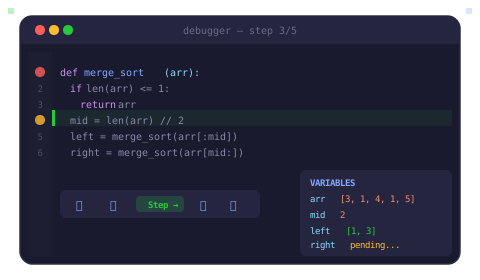
ESLint and Prettier run on every file. Step 1: read the assignment brief and identify the test runner (Jest, Vitest, React Testing Library, Cypress, or Playwright) and the bundler (Vite, Webpack, or Bun). Step 2: sketch the component tree for front-end work, the route table for back-end work.
Step 3: write the components or routes with type annotations in TypeScript or JSDoc. Step 4: write Jest or Vitest unit tests, React Testing Library integration tests, and Cypress or Playwright end-to-end tests covering the happy path and the error cases. Step 5: run the suite locally and confirm zero failures before delivery.
What you receive
Every JavaScript delivery ships with the .js, .jsx, .ts, or .tsx source files in the directory layout your assignment expects, Jest or Vitest test files matching the autograder format the brief specifies, a SOLUTION.md with the design rationale and a component-tree diagram, and a CHECKLIST.md mapping each rubric item to where the code satisfies it. The bundle adds a package.json with pinned versions, an ESLint config matching the required style, and a 5-bullet oral-defense brief covering the 3 questions a grader is most likely to ask about your async patterns or component architecture.
Assignment Types
Component-driven UIs with hooks or the composition API, client-side routing, and Context API, Redux Toolkit, or Pinia state. Named pitfall: an array index used as a React key prop, which breaks reconciliation on reorder; swapped for a stable ID from the data.
A REST API with CRUD endpoints, JWT authentication, bcrypt password hashing, and a PostgreSQL or MongoDB layer via Prisma, Sequelize, or Mongoose. Named pitfall: an N+1 query from lazy ORM loading, fixed with eager include or a DataLoader batch.
Promise composition, async/await error handling, AbortController cancellation, and debounce or throttle patterns, delivered with a microtask-vs-macrotask timeline. Named pitfall: an async callback without try/catch that swallows the error in the browser and crashes Node by default.
Generics with extends constraints, discriminated unions with literal tags, type guards, and utility types (Partial, Pick, Omit) over an existing JavaScript codebase. Named pitfall: a non-exhaustive switch over a discriminated union that compiles until a new variant is added, caught with a never assertion in the default branch.
Interactive SVG charts with d3-scale, d3-axis, and d3-transition, tooltips, and responsive layouts that re-render on container resize. Named pitfall: a data join that appends duplicate elements on every update because the enter, update, and exit selections are not separated.
REST endpoints with Express plus Zod validation, or a GraphQL server with resolvers, DataLoader batching, and Apollo Client cache normalization on the front end. Named pitfall: Apollo cache misses from a custom field selection missing __typename or id, found with the Apollo DevTools cache inspector.
Jest or Vitest unit tests, React Testing Library integration tests, and Cypress or Playwright end-to-end runs with coverage above 80%. Named pitfall: a Playwright locator that matches multiple elements and raises a strict-mode violation, narrowed with getByRole.
Advanced Topics
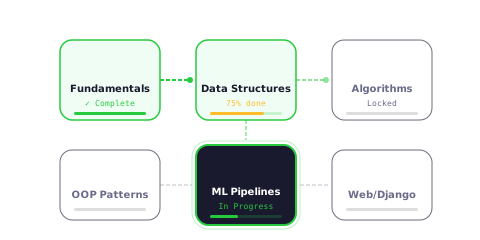
Virtual DOM diffing, preventing re-renders with React.memo, useMemo, and useCallback, code splitting with React.lazy and Suspense, and React DevTools Profiler for flamegraph analysis.
Generics with extends constraints, conditional types, mapped types, discriminated unions with literal types, utility types (Partial, Pick, Omit, Required), and type guards.
Event loop internals, cluster module for multi-core scaling, worker_threads for CPU-bound work, streaming with Readable and Writable streams, and microservices with message queues.
Jest or Vitest unit tests, React Testing Library integration tests, Cypress or Playwright E2E tests with visual regression, TDD methodology, and code coverage above 80%.
Sample Output
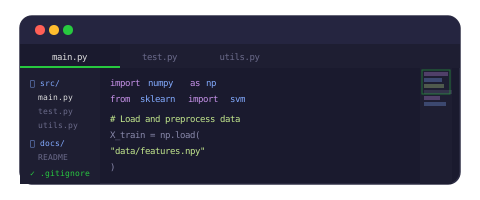
// Debounced async search with AbortController
async function debouncedSearch(query, delay = 300) {
  clearTimeout(debouncedSearch._timer);
  debouncedSearch._ctrl?.abort();

  return new Promise((resolve) => {
    debouncedSearch._timer = setTimeout(async () => {
      const ctrl = new AbortController();
      debouncedSearch._ctrl = ctrl;
      const res = await fetch(
        `/api/search?q=${query}`,
        { signal: ctrl.signal }
      );
      resolve(await res.json());
    }, delay);
  });
}
Tools & Environment
Sample Projects
React frontend with Context API state, Node.js plus Express API, PostgreSQL with Prisma ORM, Stripe payment integration, and JWT authentication with refresh tokens.
Socket.IO with private messaging, rooms, typing indicators, message history persisted to PostgreSQL, and presence detection with idle timeout.
React with D3.js charts, real-time updates via Server-Sent Events, filterable tables with virtualized rendering for 10,000+ rows, and CSV export.
Express, JWT tokens with refresh-token rotation, bcrypt password hashing, role-based access control, Joi input validation, and express-rate-limit for DoS protection.
Tutors who cover this language
MS CS
750+ assignments completed
PhD CS
1,200+ assignments completed
FAQ
Browse
Submit your assignment and get matched with a verified JavaScript tutor. Anonymous handles, encrypted upload, files auto-delete 30 days after delivery.
Submit JavaScript Assignment