Machine Learning & AI
NumPy vectorization, scikit-learn pipelines, PyTorch and TensorFlow autograd, and the cross-validation patterns autograders test.

Multi-Paradigm Language
Annotated Jupyter notebooks and pytest-passing scripts for machine learning, pandas data analysis, and algorithm assignments, with type hints and ruff formatting throughout. The single biggest score drop in a machine learning assignment is data leakage from fitting a StandardScaler before the train/test split, the exact failure mode our tutors fix with a scikit-learn Pipeline that scopes per fold. Verified CS graduates with ML pipeline depth, from $20 per task, 12-hour average turnaround.
Why Python
Annotated Jupyter notebooks and pytest-passing scripts for machine learning, pandas data analysis, and algorithm assignments, with type hints and ruff formatting throughout. The single biggest score drop in a machine learning assignment is data leakage from fitting a StandardScaler before the train/test split, the exact failure mode our tutors fix with a scikit-learn Pipeline that scopes per fold. Verified CS graduates with ML pipeline depth, from $20 per task, 12-hour average turnaround.
Topics covered
NumPy vectorization, scikit-learn pipelines, PyTorch and TensorFlow autograd, and the cross-validation patterns autograders test.
Pure-Python implementations with explicit invariants, Big-O proofs, and pytest cases covering the boundary inputs TAs grade hardest.
argparse CLI tools, subprocess pipelines, regex parsers, and idempotent file-system operations that survive partial failures.
Implementation patterns, named pitfalls, and the autograder cases that catch them in Python coursework.
Implementation patterns, named pitfalls, and the autograder cases that catch them in Python coursework.
Implementation patterns, named pitfalls, and the autograder cases that catch them in Python coursework.
Related
Full overview
Python is the teaching language for introductory programming, data science, and machine learning coursework across most computer science programs. An intro programming course leans on lists, dictionaries, higher-order functions, and recursion while students learn control flow and decomposition. A data science course grades pandas exploratory analysis, scikit-learn modeling, hypothesis testing, and bootstrap inference, with the autograder checking numeric outputs to 4 decimal places.
A machine learning assignment moves to supervised and unsupervised learning, neural networks in PyTorch, cross-validation, and bias-variance decomposition, where the most common deduction is data leakage from preprocessing the full dataset before the split. A web development assignment builds REST APIs with FastAPI or Django, Pydantic validation, and an ORM layer tested against a real database. Our Python tutors deliver code with type hints on every public function (PEP 484), Google-style docstrings, and pytest fixtures covering empty input, single element, and the adversarial inputs that trigger boundary cases the grading rubric rewards.
Data science work ships as annotated Jupyter notebooks with markdown explanations, labeled matplotlib or seaborn plots, reproducible random seeds, and clean cell organization the grader can re-run end-to-end. The assessment split runs roughly 70-30 between implementation projects graded against held-out test cases and written components that test modeling judgment and complexity analysis. Both halves reward one skill: reasoning about data flow and shape one level above the code.
The CSHH bench for Python pairs verified CS graduates with ML pipeline depth (cross-validation discipline, PyTorch autograd, scikit-learn ColumnTransformer) and data-engineering specialists who annotate complexity on every function.
Where Students Get Stuck
A function signature like def append(item, lst=[]) creates a single list shared across all calls. The fix: use lst=None and instantiate inside the function. We add a docstring warning so the pattern stays visible to future readers.
Building a list of 10 million ints uses 400MB. Switching to a generator drops it to constant space. We refactor list comprehensions to generator expressions wherever the result is consumed once.
CPU-bound work parallelized with threading runs slower than single-threaded because the GIL serializes bytecode. We refactor to multiprocessing.Pool for CPU work and keep threading for I/O.
Shape mismatches that should raise silently broadcast to the wrong output shape. We add assert statements on shape before every matmul and use np.testing.assert_array_almost_equal in test suites.
Joining on a key with duplicates in both frames produces N*M rows. We add value_counts checks before merge and use validate="one_to_one" or "one_to_many" to catch the explosion early.
Calling fit on the whole dataset before train/test split leaks test info into training. Cross-validation scores look 5 to 15 points better than holdout. We wrap preprocessing in a Pipeline that fits per fold.
How we work
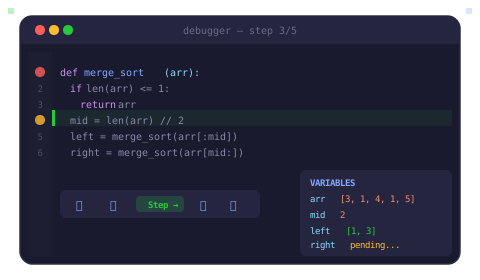
Step 1: read the grading rubric and identify the autograder format (pytest suite, doctest blocks, a Jupyter notebook checked to 4 decimal places, or the course autograder). Step 2: sketch the data flow on paper for any pipeline assignment; sketch the function signatures for any algorithm assignment. Step 3: write code with type hints on every public function (PEP 484), Google-style docstrings, and formatting enforced by ruff.
Step 4: write pytest cases with parametrize covering empty input, single element, duplicate values, and adversarial inputs, adding Hypothesis property tests where edge cases are hard to enumerate by hand. Step 5: for data science work, structure the notebook with clear markdown headers, labeled axes on every plot, reproducible seeds, and clean cell organization. Step 6: run the autograder format locally and confirm zero failures before delivery.
Any model pipeline wraps preprocessing in a scikit-learn Pipeline so cross-validation scores match holdout performance.
What you receive
Every Python delivery ships with the .py source files in the directory layout your course expects, pytest fixtures matching the autograder format (parametrized test cases, doctest blocks for intro coursework, or a notebook checked to a numeric tolerance for data science labs), a SOLUTION.md with the design rationale and complexity analysis per function, and a CHECKLIST.md mapping each rubric item to where the code satisfies it. For Jupyter notebook assignments, the bundle adds a .ipynb with all outputs cleared, a requirements.txt with pinned versions, and a 5-bullet oral-defense brief covering the 3 questions a grader is most likely to ask about your modeling choices.
Assignment Types
pandas exploratory analysis, groupby aggregations, merges, and labeled matplotlib or seaborn plots, delivered as a notebook the grader re-runs end to end. Named pitfall: a SettingWithCopyWarning from chained indexing that silently mutates a copy, annotated with the .loc fix.
scikit-learn classification and regression with ColumnTransformer preprocessing, GridSearchCV tuning, and cross-validation, plus PyTorch or TensorFlow for neural networks. Named pitfall: data leakage from fitting a scaler before the train/test split, fixed with a Pipeline that scopes per fold.
REST APIs with FastAPI and Pydantic v2 models, or Django and Django REST Framework with ORM relationships and JWT auth, tested with pytest against a real database. Named pitfall: an N+1 query from lazy ORM loading, fixed with select_related or prefetch_related.
Command-line tools with argparse, click, or typer, file processing, and API clients, with asyncio plus aiohttp where the workload is I/O-bound. Named pitfall: a blocking requests.get call inside an async function that freezes the event loop, swapped for aiohttp.ClientSession.
Hash tables, binary search trees, AVL trees, heaps, and graph adjacency lists implemented without library shortcuts, with complexity annotated per operation. Named pitfall: O(2^n) naive recursion that times out, refactored to O(n) with functools.lru_cache memoization.
BeautifulSoup with the lxml parser, requests session pooling, and Playwright or Selenium for JS-rendered pages, with robots.txt compliance and exponential-backoff retries. Named pitfall: scraping a single-page app with BeautifulSoup returns empty results because the HTML arrives before hydration, diagnosed early.
pytest suites with fixtures in conftest.py, parametrize for matrix testing, pytest-mock, and Hypothesis property tests, targeting branch coverage above 80%. Named pitfall: a function-scoped fixture that opens a database transaction but never commits, so tests pass solo and fail in a suite.
Advanced Topics
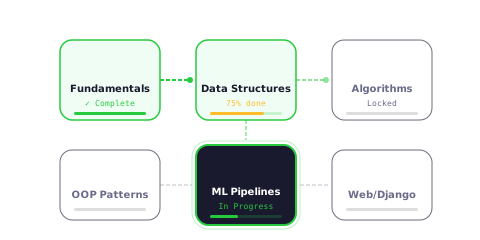
Building networks from scratch (backpropagation, gradient descent, weight initialization), then using PyTorch and TensorFlow for CNNs, RNNs, transformers, and training optimization with mixed precision.
Multi-index DataFrames, window functions, custom aggregations, time series with resample, and vectorized operations for 100x performance gains over .iterrows() loops.
GIL limitations, threading for I/O-bound tasks, multiprocessing.Pool for CPU-bound tasks, asyncio for high-concurrency I/O, and joblib for embarrassingly parallel ML workloads.
Metaclasses, descriptors, ABCs, MRO (Method Resolution Order), and dataclasses with __slots__. Essential for understanding Django ORM and Flask request handling internals.
Sample Output
# Memoized Fibonacci with O(n) complexity
from functools import lru_cache

@lru_cache(maxsize=None)
def fibonacci(n: int) -> int:
    """Return the nth Fibonacci number.
    Time: O(n) | Space: O(n)
    """
    if n <= 1:
        return n
    return fibonacci(n - 1) + fibonacci(n - 2)

# Usage: fibonacci(100) => instant
Diagnostic Walkthrough
from sklearn.preprocessing import StandardScaler
from sklearn.linear_model import LogisticRegression
from sklearn.model_selection import cross_val_score

# Bug: fit on whole dataset before CV split
scaler = StandardScaler().fit(X)        # leaks test info
X_scaled = scaler.transform(X)

model = LogisticRegression()
scores = cross_val_score(model, X_scaled, y, cv=5)
print(scores.mean()) # inflated by 5-15 pointsfrom sklearn.preprocessing import StandardScaler
from sklearn.linear_model import LogisticRegression
from sklearn.pipeline import Pipeline
from sklearn.model_selection import cross_val_score
# Fixed: preprocessor fits inside each CV fold
pipe = Pipeline([
("scale", StandardScaler()),
("clf", LogisticRegression()),
])
scores = cross_val_score(pipe, X, y, cv=5)
print(scores.mean()) # honest holdout score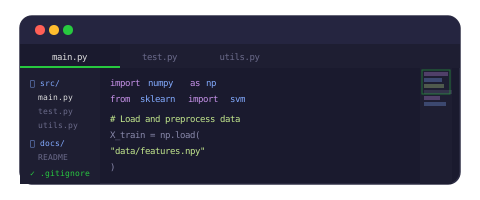
Tools & Environment
Sample Projects
End-to-end scikit-learn pipeline: preprocessing with ColumnTransformer, feature engineering, model selection across 4 algorithms, GridSearchCV tuning over 4 hyperparameters, and ROC evaluation. Final F1 improved from 0.71 baseline to 0.84.
Handles JS-rendered pages, pagination across 200 result pages, rate limiting with exponential backoff, and CSV plus JSON export with robots.txt compliance.
CRUD endpoints, JWT authentication, marshmallow input validation, SQLAlchemy ORM with Alembic migrations, and Swagger documentation auto-generated from docstrings.
Forward and backward propagation, gradient descent with momentum, ReLU and softmax activations. Demonstrates the math behind deep learning with hand-coded matrix operations.
Tutors who cover this language
PhD CS
1,200+ assignments completed
MS CS
750+ assignments completed
FAQ
Browse
Submit your assignment and get matched with a verified Python tutor. Anonymous handles, encrypted upload, files auto-delete 30 days after delivery.
Submit Python Assignment