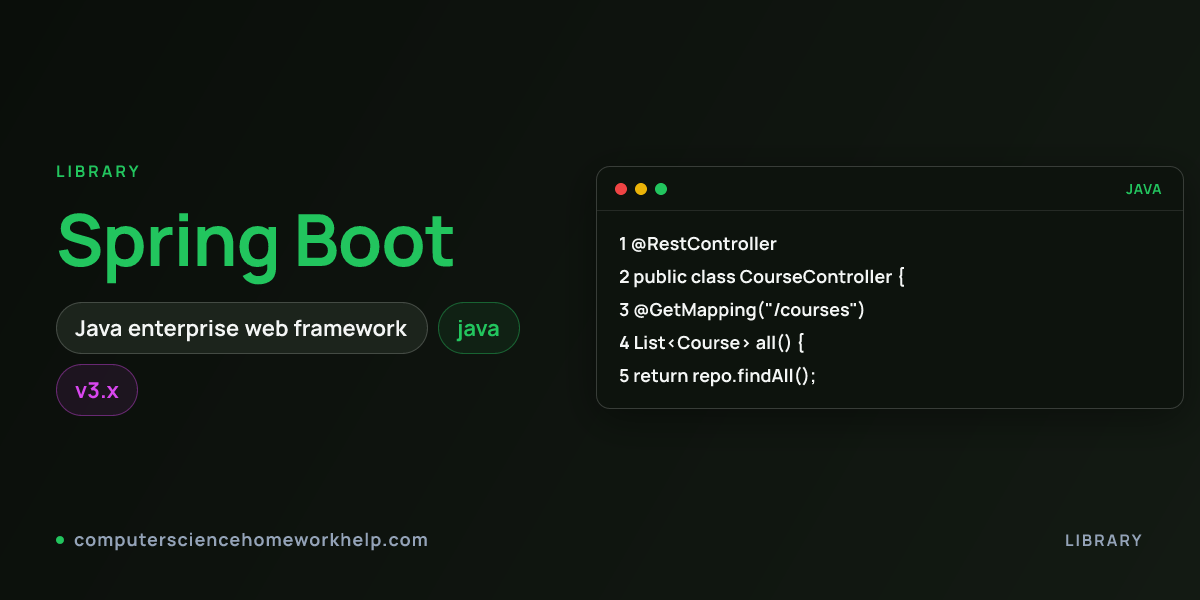
Spring Boot is the convention-over-configuration layer that sits on top of the Spring Framework and packages opinionated defaults for Java web applications. A single @SpringBootApplication annotation triggers component scanning, auto-configuration of an embedded Tomcat server on port 8080, JPA repository proxying, and ConfigurationProperties binding from application.yml. Where vanilla Spring required 40 lines of XML or Java config per data source, Spring Boot reduces it to 4 lines of application.yml plus a @Repository interface.
Students meet Spring Boot in junior-year software design and distributed systems courses when projects shift from terminal output to HTTP endpoints, and they meet it again in capstone work, microservices electives, and any internship that mentions enterprise Java. The framework runs on the JVM, builds with Maven or Gradle, and ships as an executable JAR that contains its own servlet container. Spring Boot 3 (the version most coursework now targets) requires Java 17 minimum and migrated from javax.* to jakarta.* package names, the breaking change that causes 60% of upgrade-related compilation failures we see on submitted assignments.
CSHH tutors deliver REST controllers with @RestController and @RequestMapping, JPA entities with @Entity and @ManyToOne mappings, Spring Security configuration using the new SecurityFilterChain bean (Spring Security 6 deprecated WebSecurityConfigurerAdapter), and integration tests using @SpringBootTest with @AutoConfigureMockMvc.