Cluster: Urgent Help

Urgent CS Homework Help

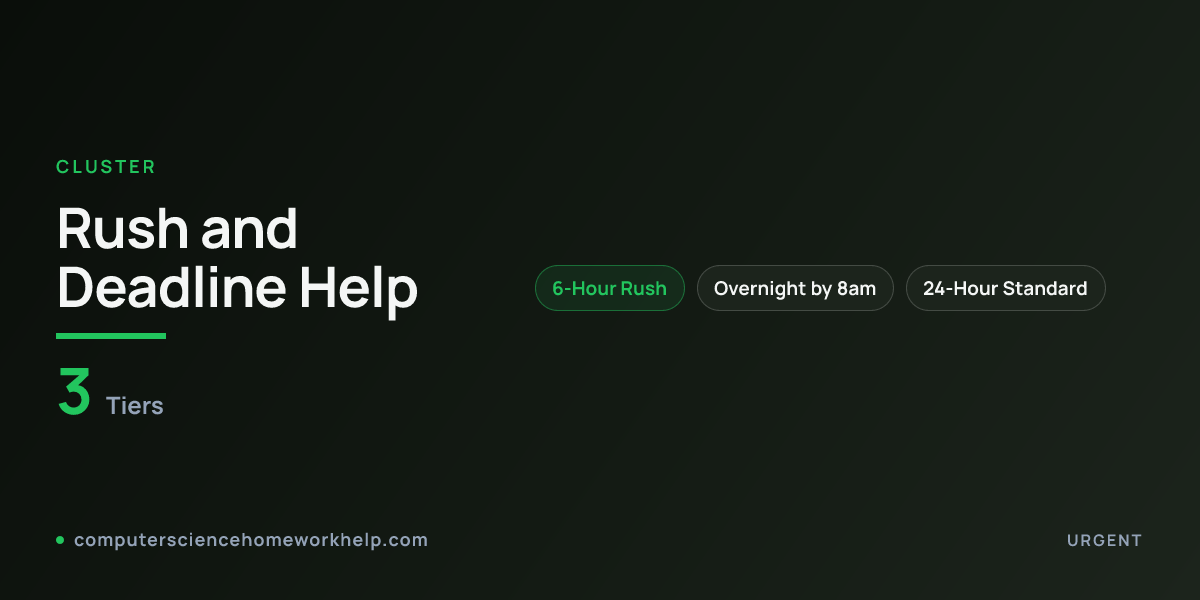
One page, three published delivery windows: a 6-hour rush for single-question Psets and debug tickets, an overnight tier that lands by 8am for the morning-deadline spike, and a 24-hour standard tier for full multi-file projects. Named tutors confirm scope inside 15 minutes across 4 timezone bands, and the timer starts at scope confirmation, not at form submission.

Montage of the three urgent delivery tiers CSHH offers: 6-hour rush, overnight by 8am, and 24-hour standard
3 Delivery Windows 6h, overnight, 24h
4 Timezone Bands EST PST GMT IST AEST coverage
99% On-Time Rate Across all urgency queues
4,200+ Logged Rush Orders In the last 12 months

Why the Urgent Cluster

Deadline-aware routing matches the way CS courses set due dates

CS coursework lands on a predictable rhythm: 9am autograder deadlines, Friday-evening Pset drops, Sunday-night submission spikes. The urgent cluster routes a brief to the window that matches the actual deadline, not to a generic priority field. A 9am deadline submitted at 10pm the night before routes to the overnight queue with a covering-shift tutor in a forward timezone, not to a 6-hour rush with a 50 percent surcharge. A single Pset question due in 4 hours routes to the rush queue with the published SLA, not to the standard 24-hour tier where it would miss. Pricing, on-time rate, and median turnaround for each window are published, evidenced, and visible before payment.

Rush Tier, 6-Hour Window

6-Hour CS Homework Help

Need working code in 6 hours? Verified CS graduates deliver compiled, tested, commented solutions on Java, Python, C++, C, JavaScript, and Assembly. Median actual turnaround for the rush tier is 4.2 hours; the 90th-percentile case lands inside 5.8 hours. Rush surcharge of 50 percent applies on top of the $20 base for Debug and Explain or $30 base for a Full Solution.

6h SLA window
4h 12m Median turnaround
5h 48m 90th percentile
98% On-time rate

$30 Debug and Explain or $45 Full Solution, plus 50 percent rush surcharge.

Overnight Tier, 12-Hour Window

Overnight CS Help

Submit a CS assignment by 10pm in your local timezone, and a verified tutor on a covering shift delivers a working, commented solution by 8am the next morning. Coverage runs across 4 timezone bands: North America EST and PST, Europe and UK GMT and CET, India and South Asia IST, Australia AEST. Pricing on the overnight tier sits between the standard 24-hour rate and the 6-hour rush, at $30 Debug and Explain or $45 Full Solution.

8am Morning cutoff
10pm Submit by (local)
4 Timezone bands
99.1% On-time rate

$30 Debug and Explain or $45 Full Solution. Submit by 10pm local.

Standard Tier, 24-Hour Window

24-Hour CS Homework Help

Next-day delivery on the standard CSHH tier covers the full Pset surface: multi-file Java projects, Python data-science notebooks, C++ template-metaprogramming exercises, full React or Node assignments, Assembly traces with register diagrams. Across the last 2,800 logged orders the 24-hour queue ran a 98.4 percent on-time rate. Pricing stays at the $20 Debug and Explain or $30 Full Solution baseline with no rush surcharge.

24h SLA window
17h 42m Median turnaround
22h 36m 95th percentile
98.4% On-time rate

$20 Debug and Explain or $30 Full Solution. No rush surcharge.

Included on Every Tier

What every urgency tier includes

Compiled, tested code matched to the course toolchain

Every solution ships compiled and tested against the version the course uses: Java 17, Python 3.11, C++17, C99, Node 20, or the matching Assembly toolchain. Function signatures, class names, and output format match the rubric character for character.

Inline comments and a top-of-file walkthrough

A 5 to 8 line summary at the top of every file, plus per-method comments naming the data structure, the invariant, and the Big-O complexity. The walkthrough is the artifact you study before submitting.

Autograder format and hidden-test coverage

The solution passes the visible Gradescope cases plus 4 to 8 hidden edge cases the tutor adds to surface the deductions graders look for. File structure and naming match the spec.

A named tutor before you pay

You see the tutor name, credential, specialization, and solved-count in the order thread before any payment confirmation. No anonymous queue.

Free revisions after delivery

Autograder failures, rubric updates, and instructor-added requirements get patched free for 7 days after delivery, or 48 hours on the 6-hour rush tier. Revisions after the window reopen at the standard tier.

Optional Loom walkthrough video

A 5 to 15 minute recorded walkthrough of the design decisions, data-structure choices, and test strategy adds $20 to any tier, useful for an in-class submission with a question-and-answer defense.

FAQ

Urgent CS homework help FAQ

When does the delivery clock start?
At tutor scope confirmation, not at form submission. A tutor reviews the brief, rubric, and any starter code within 15 minutes, posts a matching message with name and credential, and the timer begins. A client-side delay, such as no answer to a scope question, pauses the clock.
What happens if you miss the SLA window?
Full refund on the 6-hour rush tier. On the 24-hour and overnight tiers, a slip caused by tutor availability or a rubric ambiguity is covered by a partial refund or a deadline extension. A miss caused by missing inputs pauses the clock instead of penalizing the order.
Which languages and toolchains do you cover?
Java, Python, C++, C, JavaScript and TypeScript, and Assembly (x86-64 NASM, ARMv8, MIPS, RISC-V) on every tier, with SQL across PostgreSQL, MySQL, and SQLite. Long-tail languages on the standard tier include Haskell, OCaml, Rust, Go, Kotlin, Swift, Scala, MATLAB, R, and Ruby.
How does the overnight covering-shift model work?
A student in Eastern Time submits at 10pm; the order routes to a tutor on the India Standard Time morning shift, whose workday starts at 11pm Eastern and delivers by 5am Eastern, inside the 8am promise. The reverse routes late-shift North American tutors to India and Australia overnight submissions.
What fits a 6-hour rush versus the 24-hour tier?
The rush tier suits a single Pset question, a debug-and-fix ticket on existing code, a memory-leak hunt, or a 1-page algorithm trace, under 400 lines of new code. Multi-file projects, full data-science notebooks, and complete REST APIs fit the 24-hour tier. Multi-week capstones need a project-quoted window.
Is rushed code lower quality than standard delivery?
No. Every tier draws from the same verified tutor pool and ships with the same inline comments, Big-O annotations, autograder compliance, and hidden-test coverage. The difference is queue priority, not the delivery standard.
Do you cover live tutoring or only code delivery?
Code delivery is the urgency tier. Live one-on-one tutoring runs on a separate $40 per hour model with a 1-hour minimum and pre-booked slots. The two stack: you can book a debrief on a delivered solution at the live rate.
Explore Related Clusters

Pair this with our other coverage

Full Pricing Tiers

Standard, project, and live tutoring rates with refund terms. The published price band you compare against before a rush surcharge applies.

See Pricing

How It Works

From form submission to tutor confirmation to delivery thread. The 15-minute scope-confirm window that anchors every urgency timer.

See the Process

Meet the Tutors

Named tutors with credentials, specialties, and assignment counts. See who routes to which urgency queue and which language stack.

Meet the Tutors

Slots Filling Now

Deadline tonight? Submit now.

A verified tutor confirms scope inside 15 minutes. The urgency timer starts at scope confirmation, not at form submission, so the brief and rubric arrive together or the window pauses.

Submit Your Assignment