Propositional Logic
Propositional Logic in Discrete Mathematics: implementation patterns, named pitfalls, and the autograder cases that catch them.
Computer Science Foundations
Propositional and first-order logic, induction and contradiction proofs, set theory and relations, combinatorial counting with inclusion-exclusion, graph theory through chromatic number, and number-theoretic algorithms. A common grading deduction is an induction proof that assumes the inductive hypothesis on the wrong variable, the structural error our tutors catch with explicit base-case plus inductive-step labeling. Verified CS graduates, starting at $20 per task, 12-hour average turnaround.
Why Discrete Mathematics
Propositional and first-order logic, induction and contradiction proofs, set theory and relations, combinatorial counting with inclusion-exclusion, graph theory through chromatic number, and number-theoretic algorithms. A common grading deduction is an induction proof that assumes the inductive hypothesis on the wrong variable, the structural error our tutors catch with explicit base-case plus inductive-step labeling. Verified CS graduates, starting at $20 per task, 12-hour average turnaround.
Topics covered
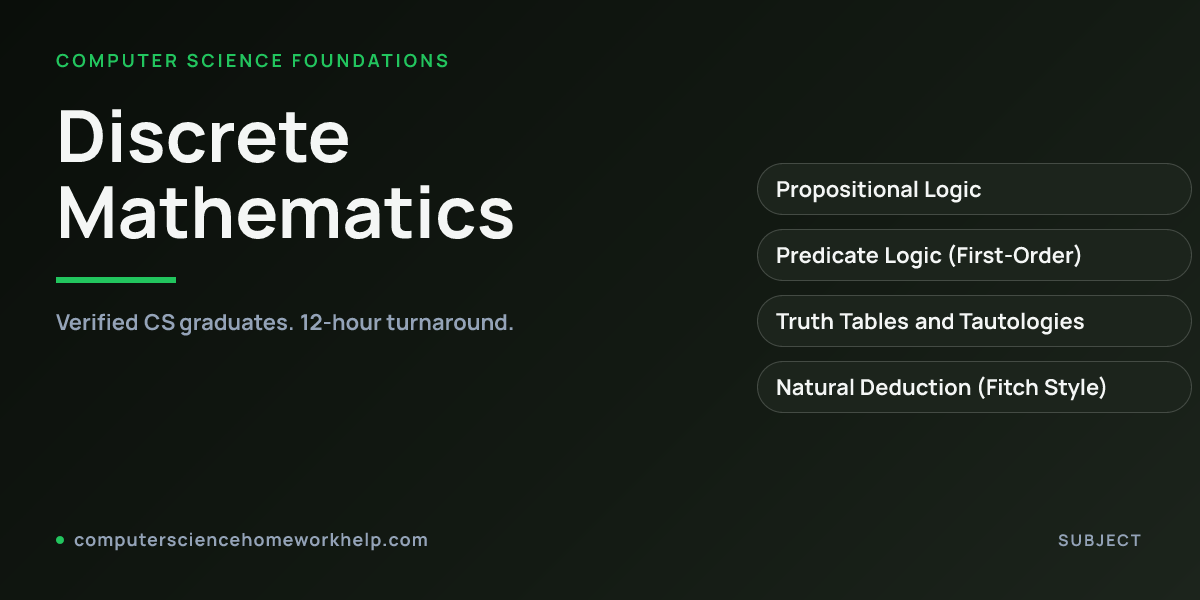
Propositional Logic in Discrete Mathematics: implementation patterns, named pitfalls, and the autograder cases that catch them.
Predicate Logic (First-Order) in Discrete Mathematics: implementation patterns, named pitfalls, and the autograder cases that catch them.
Truth Tables and Tautologies in Discrete Mathematics: implementation patterns, named pitfalls, and the autograder cases that catch them.
Natural Deduction (Fitch Style) in Discrete Mathematics: implementation patterns, named pitfalls, and the autograder cases that catch them.
Proof by Induction (Weak and Strong) in Discrete Mathematics: implementation patterns, named pitfalls, and the autograder cases that catch them.
Proof by Contradiction in Discrete Mathematics: implementation patterns, named pitfalls, and the autograder cases that catch them.
Full overview
Discrete mathematics is the mathematical foundation underneath every CS subject. Discrete math courses cover 8 named topic areas: propositional and predicate logic (truth tables, natural deduction, resolution, satisfiability), proof techniques (direct, contrapositive, contradiction, strong and weak induction, structural induction, well-ordering), set theory and relations (cardinality, Cantor diagonalization, equivalence relations, partial orders, lattices), functions and bijections (injection, surjection, pigeonhole, schroder-bernstein), combinatorics (permutations, combinations, binomial identities, inclusion-exclusion, generating functions), number theory (divisibility, gcd via Euclidean algorithm, modular arithmetic, Fermat little theorem, Chinese remainder theorem, RSA foundations), graph theory (paths, cycles, trees, planarity, Euler and Hamiltonian properties, chromatic number, matching theory, Ramsey theory), and formal language theory (regular languages and finite automata, context-free languages and pushdown automata, Turing machines and decidability, pumping lemmas, Chomsky hierarchy). A typical discrete math course spends 13 to 15 weeks on these topics with Rosen, Lehman-Leighton-Meyer, or Epp as the textbook.
The assessment landscape is roughly 70-30 written problem sets over exams because proof-writing requires careful argument that is hard to grade in real time. Proof-heavy problem sets are notorious for 8-hour completion times, and many courses grade both proof correctness and proof clarity (a correct proof badly written loses 30% of the credit). The required proof style is formal: every step justified, every quantifier bound, every base case verified.
CSHH tutor matching for this subject draws from CS graduates with mathematical maturity: former math-competition participants, math majors who minored in CS, plus theoretical CS PhDs comfortable with the standard textbook style. Our tutors deliver proofs in the canonical formats: 2-column for elementary geometry-style proofs, numbered-step format for induction, prose with displayed equations for analysis-style arguments, semantic tableaux or natural deduction trees for logic. Each proof comes with a 1-paragraph proof strategy memo explaining why the chosen technique fits the problem.
Languages supported: Lean 4 and Coq for formal proof verification on advanced assignments, Python and Haskell for combinatorial computation, Mathematica or SageMath for symbolic checking.
Where Students Get Stuck
Base case: verify the claim for the smallest n in scope (usually n equal to 0 or n equal to 1). Inductive hypothesis: assume the claim holds for some specific k (or for all k less than n in strong induction). Inductive step: prove the claim for k plus 1 (or n) using the hypothesis. We label each part explicitly and verify the induction variable is correct.
Negate forall by swapping to exists with negated predicate: not(forall-x P(x)) equals exists-x not(P(x)). Negate exists by swapping to forall with negated predicate. Compound quantifiers: not(forall-x exists-y P(x,y)) equals exists-x forall-y not(P(x,y)). We work through the negation step-by-step on the standard examples.
Two sets have the same cardinality if and only if there exists a bijection between them. Cantor diagonalization proves the reals are uncountable (no bijection from naturals to reals). Schroder-Bernstein theorem: if there exist injections A to B and B to A, there exists a bijection A to B. We construct explicit bijections for counting arguments and apply Cantor for uncountability proofs.
Count the union of n sets by alternating sums across all 2 to the n subsets: |A1 union A2 union ... An| equals sum |Ai| minus sum |Ai intersect Aj| plus sum |Ai intersect Aj intersect Ak| minus ... . The classic application: derangements (permutations with no fixed point). We track each term explicitly and verify on small cases (e.g., n equal to 3 gives 6 subsets).
Ordinary generating functions for sequences: f(x) equals sum a_n x to the n. Convert a recurrence (a_n equals a_{n-1} plus a_{n-2} for Fibonacci) to an algebraic equation in f(x), solve for f(x), then extract closed-form coefficients via partial fractions or power-series expansion. Exponential generating functions for labeled structures.
gcd(a, b) computed by Euclidean algorithm: gcd(a, b) equals gcd(b, a mod b) until b equals 0. Extended Euclidean computes integers x and y such that ax plus by equals gcd(a, b). We trace the algorithm on worked examples (gcd(252, 105) equals 21 with x and y derived by back-substitution) and use the Bezout coefficients for modular inverse.
Assignment Types
Direct, contrapositive, contradiction, and weak and strong induction proofs in labeled canonical format. Named pitfall: assuming the inductive hypothesis on the variable being inducted over, which assumes the goal it should prove.
Truth tables, natural deduction, and quantifier negation in Fitch-style or tableau format. Named pitfall: negating a nested quantifier without swapping every quantifier, producing a statement that means something different.
Equivalence relations, partial orders, bijection arguments, and Cantor diagonalization. Named pitfall: confusing element membership with the subset relation, which breaks power-set and cardinality arguments.
Permutations, combinations, inclusion-exclusion, and generating-function counting verified on small cases. Named pitfall: double-counting arrangements with repeated elements by treating identical items as distinct.
Euclidean gcd, modular arithmetic, Fermat little theorem, and Chinese remainder theorem with RSA foundations. Named pitfall: dividing modulo n when the divisor is not coprime to n, where the modular inverse does not exist.
Path, cycle, tree, planarity, Eulerian, and chromatic-number arguments with explicit small-case diagrams. Named pitfall: conflating a walk, trail, and path, then applying a theorem that holds only for repeat-free paths.
Regular and context-free languages, finite automata, and pumping-lemma non-regularity proofs. Named pitfall: applying the pumping lemma to a language that is actually regular, since the lemma is necessary but not sufficient.
Tutors Who Cover This Subject
PhD CS
1,200+ assignments completed
MS CS
980+ assignments completed
MS CS
750+ assignments completed
FAQ
Submit your assignment and get matched with a verified Discrete Mathematics tutor in 15 minutes.
Submit Your Assignment