6 anonymized solutions
AVL tree in Java, Dijkstra in Python, linked list in C++, logistic regression, REST API in Node, xv6 syscall in C.
Gallery
6 anonymized samples showing how CSHH delivers a CS homework solution. Each entry: the brief, the approach, the working code, test coverage, and the grade the student received.
Overview
At a glance
AVL tree in Java, Dijkstra in Python, linked list in C++, logistic regression, REST API in Node, xv6 syscall in C.
Each sample lists the assignment brief, the CSHH approach, the key snippet, test coverage, and the grade obtained.
Inline comments explain design decisions. The student can defend the solution in an oral exam or rubric meeting.
Section 1 of 7
Assignment brief: implement a generic AVL tree with insert, delete, search, in-order traversal, and rebalance. Pass 28 JUnit tests covering height invariants and rotation correctness. Provided as a skeleton with method signatures; student fills in the bodies.
CSHH approach: the bug-prone parts of an AVL tree are the 4 rotation cases and the rebalance trigger after recursive insert and delete. Solution implements balanceFactor as a single helper, dispatches to rotateLeft / rotateRight / rotateLeftRight / rotateRightLeft based on the sign and direction. Recursive insert returns the (possibly new) subtree root, which the parent reassigns. Delete uses the in-order successor for the two-child case.
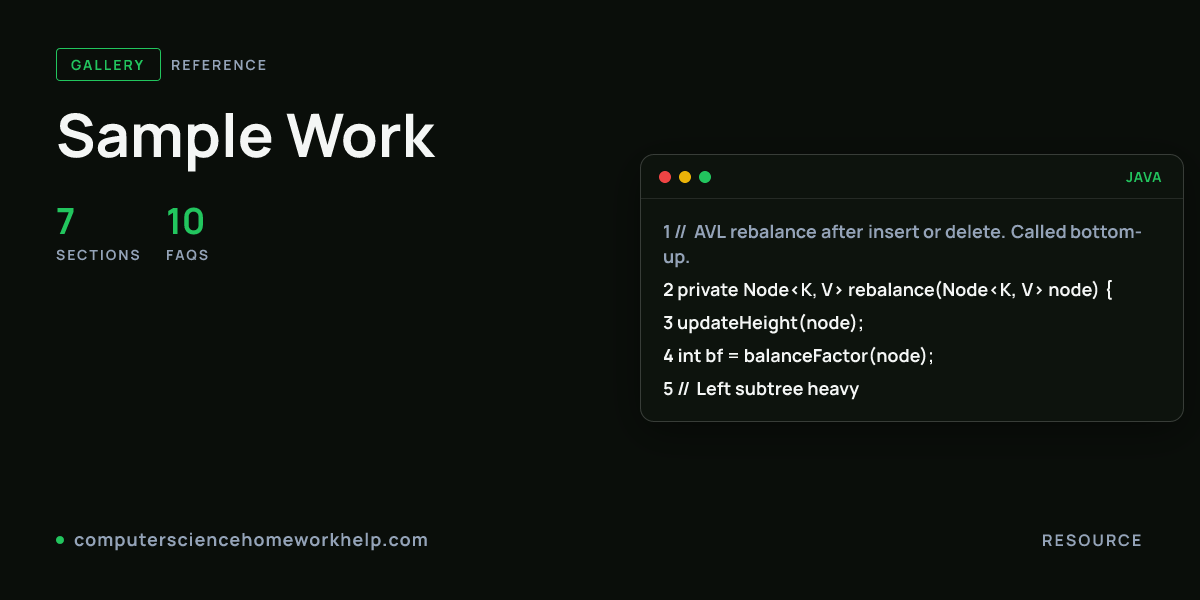
rebalance)// AVL rebalance after insert or delete. Called bottom-up.
private Node<K, V> rebalance(Node<K, V> node) {
updateHeight(node);
int bf = balanceFactor(node);
// Left subtree heavy
if (bf > 1) {
if (balanceFactor(node.left) >= 0) {
return rotateRight(node); // Left-Left
} else {
node.left = rotateLeft(node.left);
return rotateRight(node); // Left-Right
}
}
// Right subtree heavy
if (bf < -1) {
if (balanceFactor(node.right) <= 0) {
return rotateLeft(node); // Right-Right
} else {
node.right = rotateRight(node.right);
return rotateLeft(node); // Right-Left
}
}
return node; // already balanced
}Section 2 of 7
Assignment brief: implement single-source shortest path using Dijkstra's algorithm on a weighted directed graph. Read graph from a CSV file (one edge per line: source, destination, weight). Output shortest distance from a given source to every reachable vertex. Handle disconnected components.
CSHH approach: heapq for the priority queue, dict-of-list adjacency, lazy deletion of stale heap entries (push the new distance, skip on pop if the popped distance is greater than the current best). The pattern avoids the decrease_key operation Python's heapq does not expose.
import heapq
import csv
from collections import defaultdict

def parse_graph(path):
    """Parse CSV into adjacency list: {src: [(dst, weight), ...]}."""
    g = defaultdict(list)
    with open(path) as f:
        for src, dst, w in csv.reader(f):
            g[src].append((dst, float(w)))
    return g

def dijkstra(graph, source):
    """Single-source shortest path. O((V + E) log V)."""
    dist = {source: 0}
    pq = [(0, source)]
    while pq:
        d, u = heapq.heappop(pq)
        if d > dist.get(u, float("inf")):
            continue   # stale entry from a prior decrease
        for v, w in graph[u]:
            nd = d + w
            if nd < dist.get(v, float("inf")):
                dist[v] = nd
                heapq.heappush(pq, (nd, v))
    return dist
Section 3 of 7
Assignment brief: implement a doubly linked list template class with iterator support that passes the C++ standard library iterator concept requirements. Detect memory leaks under Valgrind. No use of std::list or other STL containers in the implementation.
CSHH approach: RAII destructor walks the list and deletes every node. Iterator class implements operator++, operator--, operator*, operator==, and tags itself with std::bidirectional_iterator_tag so range-based for loops work. Move constructor and move assignment leave the source in a valid empty state.
template <typename T>
class LinkedList {
private:
    struct Node {
        T value;
        Node* prev = nullptr;
        Node* next = nullptr;
        explicit Node(T v) : value(std::move(v)) {}
    };
    Node* head_ = nullptr;
    Node* tail_ = nullptr;
    std::size_t size_ = 0;

public:
    LinkedList() = default;

    // RAII destructor frees every node
    ~LinkedList() {
        Node* cur = head_;
        while (cur) {
            Node* next = cur->next;
            delete cur;
            cur = next;
        }
    }

    // Move constructor leaves source empty but valid
    LinkedList(LinkedList&& other) noexcept
        : head_(other.head_), tail_(other.tail_), size_(other.size_) {
        other.head_ = other.tail_ = nullptr;
        other.size_ = 0;
    }

    void push_back(T value) {
        Node* n = new Node(std::move(value));
        n->prev = tail_;
        if (tail_) tail_->next = n;
        else head_ = n;
        tail_ = n;
        size_++;
    }
};
Section 4 of 7
Assignment brief: implement binary logistic regression from scratch (no scikit-learn). Train on the breast cancer dataset (provided as CSV), report accuracy on a held-out test set above 95%. Use gradient descent; choose learning rate and iterations.
CSHH approach: NumPy for vectorized matrix operations, sigmoid activation, binary cross-entropy loss with L2 regularization. Train-test split 80/20 with fixed seed for reproducibility. Mini-batch gradient descent with batch size 32, learning rate 0.01, 1000 epochs.
import numpy as np

class LogisticRegression:
    def __init__(self, lr=0.01, epochs=1000, l2=0.01, batch_size=32, seed=42):
        self.lr = lr
        self.epochs = epochs
        self.l2 = l2
        self.batch_size = batch_size
        self.rng = np.random.default_rng(seed)
        self.w = None
        self.b = 0.0

    def _sigmoid(self, z):
        return 1.0 / (1.0 + np.exp(-np.clip(z, -500, 500)))

    def fit(self, X, y):
        n, d = X.shape
        self.w = np.zeros(d)
        for _ in range(self.epochs):
            idx = self.rng.permutation(n)
            for start in range(0, n, self.batch_size):
                batch = idx[start:start + self.batch_size]
                Xb, yb = X[batch], y[batch]
                pred = self._sigmoid(Xb @ self.w + self.b)
                grad_w = Xb.T @ (pred - yb) / len(yb) + self.l2 * self.w
                grad_b = np.mean(pred - yb)
                self.w -= self.lr * grad_w
                self.b -= self.lr * grad_b
        return self

    def predict(self, X):
        return (self._sigmoid(X @ self.w + self.b) >= 0.5).astype(int)
Section 5 of 7
Assignment brief: build a REST API for a library catalog. CRUD endpoints for books, authors, and loans. Use Node, Express, and SQLite. 90%+ test coverage with Jest. Include input validation and error handling. Document endpoints in OpenAPI 3.0.
CSHH approach: layered architecture (route handlers → service layer → repository layer → SQLite). Joi for input validation. Express error-handling middleware that converts thrown errors into JSON responses with HTTP status codes. Jest for unit tests, supertest for integration tests against an in-memory SQLite instance.
// Express route with validation + error handling
const express = require('express');
const Joi = require('joi');
const { BookService } = require('./services/book');

const router = express.Router();
const bookSchema = Joi.object({
    title: Joi.string().min(1).max(200).required(),
    authorId: Joi.number().integer().positive().required(),
    isbn: Joi.string().pattern(/^[0-9-]{10,17}$/).required(),
});

router.post('/books', async (req, res, next) => {
    try {
        const { value, error } = bookSchema.validate(req.body);
        if (error) {
            return res.status(400).json({ error: error.message });
        }
        const book = await BookService.create(value);
        res.status(201).json(book);
    } catch (err) {
        next(err);
    }
});

// Centralized error handler converts thrown errors to HTTP responses
function errorHandler(err, req, res, next) {
    const status = err.status || 500;
    res.status(status).json({ error: err.message });
}

module.exports = { router, errorHandler };
Section 6 of 7
Assignment brief: add a getreadcount system call to xv6 that returns the number of times read has been called since boot. Modify syscall.c, syscall.h, sysproc.c, user.h, and the Makefile. Provide a user-space test program. The call must increment atomically across processes.
CSHH approach: add a global counter protected by a spinlock. Increment in sys_read before dispatching to the file descriptor handler. Define the system call number, prototype in user header, dispatcher entry, and user-space stub. Test program forks 4 children, each calls read 100 times on /dev/null, parent verifies the counter equals 400.
perf at less than 0.1% overhead per call/* sysproc.c: implement sys_getreadcount and instrument sys_read */
#include "types.h"
#include "defs.h"
#include "spinlock.h"
static struct spinlock readcount_lock;
static uint64 readcount = 0;
static int initialized = 0;
uint64 sys_getreadcount(void) {
uint64 count;
if (!initialized) {
initlock(&readcount_lock, "readcount");
initialized = 1;
}
acquire(&readcount_lock);
count = readcount;
release(&readcount_lock);
return count;
}
/* Hook called from sys_read before the actual read dispatch */
void incr_readcount(void) {
if (!initialized) {
initlock(&readcount_lock, "readcount");
initialized = 1;
}
acquire(&readcount_lock);
readcount++;
release(&readcount_lock);
}Section 7 of 7
Six samples across 3 languages and 5 subject areas. Four common threads:
Submit your own assignment via the submission form to get a sample of comparable quality on your specific brief. Pricing is fixed at the tier listed on the pricing page; no per-page or per-hour surprises.
More Resources
Time and space complexity for every common data structure and algorithm. Same operation shown across Java, Python, C++, and JavaScript so you can compare directly.
Open Big-O Cheatsheet40 errors across 5 languages, every one paired with the verbatim compiler output, root cause, and the Broken vs Fixed snippet that resolves it.
Open Common Compiler ErrorsA repeatable 5-step process for finding bugs in C, C++, Java, Python, and JavaScript. With actual GDB session output, a Valgrind trace, and a pytest reproduction template.
Open Debugging GuideFAQ
Cheatsheets and guides cover the general ground. For your specific brief, submit it and get expert pedagogical help within 12 hours.
Submit Assignment