← All Libraries

Python machine learning framework

TensorFlow Homework Help

Keras models, tf.function tracing, custom training loops, and GPU training for university ML coursework. The top failure mode on multi-GPU labs is forgetting to set memory growth before the first tf.config call, the GPU OOM our tutors patch in one line. Verified CS graduates from Georgia Tech, Purdue, and BITS Pilani, starting at $20 per task, 12-hour average turnaround.

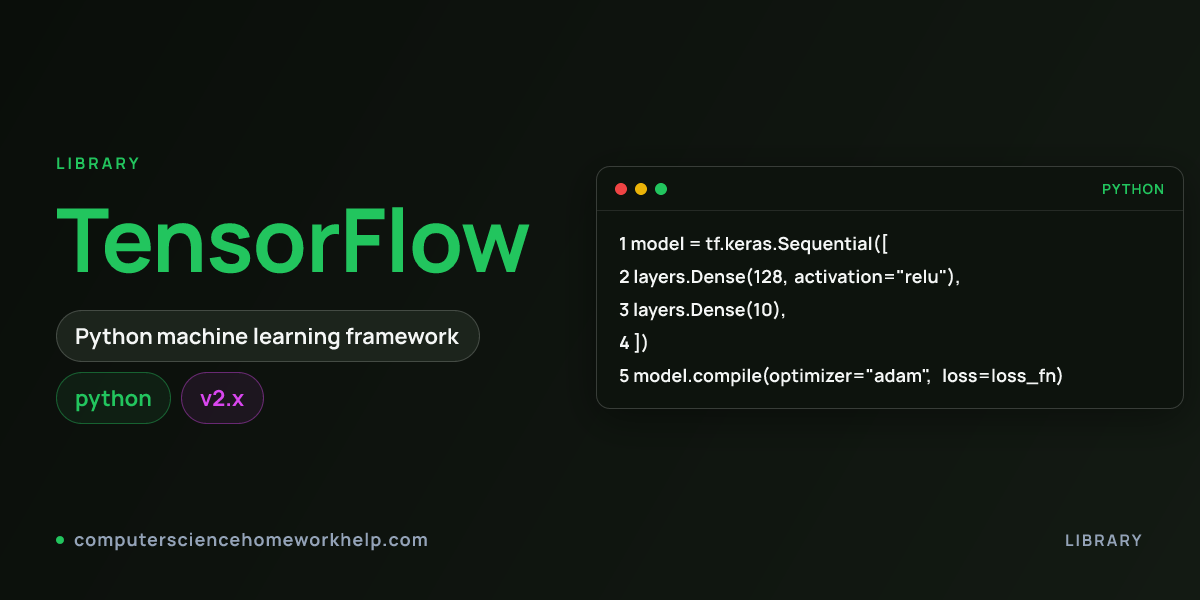
TensorFlow hero visual showing the library name and an idiomatic code snippet
2.x Version
Python Primary Language
7 Common Project Types
9 Answered FAQs

About

About TensorFlow

TensorFlow is an end-to-end machine learning framework that compiles Python or graph-based models into optimized execution across CPU, GPU, and TPU hardware. The 2.x release line made eager execution the default while keeping tf.function as the bridge to graph-mode performance, integrated Keras as the high-level API (tf.keras), and added the TensorFlow Data API (tf.data) for input pipelines. Students meet TensorFlow in CS229 (Stanford Machine Learning), CS231n (Stanford CNNs), CS224n (Stanford NLP), 6.S191 (MIT Deep Learning), and any course that grades model accuracy on held-out test sets.

The library splits into Keras (high-level model building with Sequential and Functional APIs), tf.GradientTape (for custom gradient computation outside the Keras fit loop), tf.data (input pipelines with map, batch, prefetch, shuffle), and tf.distribute (strategy classes for multi-GPU and TPU training). CSHH tutors deliver Keras models with explicit input shapes and named layers (for TensorBoard interpretability), training loops with @tf.function decoration where the speed-up justifies the tracing cost, data pipelines that overlap I/O and compute via prefetch(tf.data.AUTOTUNE), GPU memory growth set before the first GPU operation (tf.config.experimental.set_memory_growth to prevent the default behavior of grabbing all available VRAM), and TensorBoard logging for loss curves, weight histograms, and the computation graph.

Coursework

Common TensorFlow Project Types

MNIST classification with a CNN

The canonical first deep learning project. Sequential model with Conv2D, MaxPooling2D, Flatten, Dense layers, sparse categorical cross-entropy loss, Adam optimizer, model.fit with validation_split=0.2, ModelCheckpoint to save the best weights, and EarlyStopping with patience=5 on val_loss. Tutors include confusion matrix on the test set and per-class accuracy breakdown.

CIFAR-10 with data augmentation

CNN with batch normalization and dropout, tf.keras.preprocessing.image.ImageDataGenerator or the newer tf.keras.layers.RandomFlip plus RandomRotation for in-graph augmentation, learning rate schedule via tf.keras.callbacks.LearningRateScheduler, and tensorboard --logdir for training curves. Common in CS231n assignment 2.

Transfer learning with EfficientNet or ResNet

Pre-trained EfficientNetB0 from tf.keras.applications with include_top=False, custom classification head, two-phase training (freeze base then fine-tune with small learning rate), and tf.data pipeline reading from a directory tree with image_dataset_from_directory. Tutors include the BatchNormalization training=False trick for fine-tuning.

LSTM for sentiment classification

tf.keras.layers.Embedding for word vectors, Bidirectional LSTM or GRU, masking for variable-length sequences, padded batches via tf.data padded_batch, and a Dense output layer with sigmoid activation. Tutors include text preprocessing with tf.keras.layers.TextVectorization which stays inside the graph for export.

Custom training loop with tf.GradientTape

Manual training step using tf.GradientTape() to compute gradients, optimizer.apply_gradients(zip(grads, model.trainable_variables)), tf.function decoration for graph-mode speed-up, custom metrics with tf.keras.metrics.Mean and Result(), and a tqdm progress bar over the data iterator. Required for GAN training, contrastive learning, and any setup that does not fit the standard fit loop.

GAN for generating images

Generator and Discriminator as separate Keras models, separate optimizers, custom training loop alternating between G and D updates, binary cross-entropy loss with label smoothing, and image generation callback that samples from the latent space every N epochs. Tutors include mode collapse diagnostics and minibatch standard deviation.

Multi-GPU training with MirroredStrategy

tf.distribute.MirroredStrategy() context manager wrapping model build and compile, batch size scaled up by number of replicas (global_batch_size = per_replica_batch * num_replicas), distributed dataset via strategy.experimental_distribute_dataset, and learning rate scaled by sqrt(num_replicas) per the linear scaling rule. Tutors include the memory-growth setup that prevents the per-process VRAM hoarding pitfall.

Debugging

TensorFlow Debugging Patterns We Teach

Broken (OOM) python
import tensorflow as tf

# TF grabs all VRAM on first GPU op
x = tf.constant([1.0])

for gpu in tf.config.list_physical_devices("GPU"):
    tf.config.experimental.set_memory_growth(gpu, True)
# RuntimeError: device already initialized
Fixed python
import tensorflow as tf

# growth set BEFORE any GPU op
for gpu in tf.config.list_physical_devices("GPU"):
    tf.config.experimental.set_memory_growth(gpu, True)

x = tf.constant([1.0])  # safe
tf.config.experimental.set_memory_growth must run BEFORE any op touches the GPU, otherwise the physical device is already initialized and the call raises RuntimeError.
Broken (retraces) python
@tf.function
def step(x, batch_size):
    # batch_size is a Python int -> new trace per value
    return tf.reduce_mean(x) * batch_size
Fixed python
@tf.function(input_signature=[
    tf.TensorSpec(shape=[None, 784], dtype=tf.float32),
    tf.TensorSpec(shape=[], dtype=tf.int32),
])
def step(x, batch_size):
    return tf.reduce_mean(x) * tf.cast(batch_size, tf.float32)
input_signature pins a single trace for variable shapes and stops tf.function from retracing on every call.

Loss returns NaN after a few batches

Either learning rate too high (gradient explosion), log of zero in custom loss (add epsilon: tf.math.log(x + 1e-7)), divide by zero in normalization, or training on int targets with categorical_crossentropy that expects one-hot. Diagnose by adding tf.debugging.check_numerics(loss, "loss is NaN") to the training step, then walking the computation backward to find the first NaN.

Validation accuracy drops on model evaluation after fit

Dropout and BatchNormalization behave differently in train versus inference mode. If you wrote a custom training loop and forgot training=True on the model call during fit, BatchNorm uses its frozen moving stats instead of batch stats, training silently underperforms. Conversely, training=True at evaluation time leaks batch statistics into the prediction. Always pass training=True only inside the training step and training=False inside evaluation.

Input pipeline is the bottleneck

GPU sits at 30% utilization during training. The data pipeline is feeding too slowly. Fix by adding .prefetch(tf.data.AUTOTUNE) at the end of the pipeline (overlaps next-batch prep with current-batch compute), .cache() if the dataset fits in memory (or to disk for larger), .map(fn, num_parallel_calls=tf.data.AUTOTUNE) for parallel preprocessing, and inspecting with tf.data.experimental.bytes_produced_stats to see the throughput per stage.

Mismatched input shape error

Model expects (None, 224, 224, 3) but receives (None, 3, 224, 224). PyTorch uses channels-first by default; TensorFlow uses channels-last. Either transpose the input (tf.transpose(x, [0, 2, 3, 1])), or build the model with data_format="channels_first" which works only on GPU not CPU. Always confirm the data format of pre-trained weights you load.

Multi-process GPU memory grows unbounded

tf.distribute.MirroredStrategy spawns one process per GPU. If memory growth is not set before the strategy is constructed, each process grabs its allocated GPU plus some scratch space on the others, leading to OOM. Set memory growth at the very top of the main module, before any imports that might initialize TensorFlow. For HuggingFace transformers, also disable the auto-tokenizer fast init that touches the GPU on import.

Saved model load fails on different TensorFlow version

A model saved with TF 2.10 fails to load in TF 2.4 because newer ops (e.g., GroupNormalization) did not exist. Use model.save(filepath, save_format="h5") for the legacy HDF5 format which has wider compatibility, or pin the TensorFlow version in requirements.txt and rebuild the consumer environment. SavedModel format is forward-compatible but not always backward-compatible.

Code Examples

Idiomatic TensorFlow Code Our Tutors Ship

Keras CNN with callbacks train.py
import tensorflow as tf
from tensorflow.keras import layers

# Set memory growth BEFORE any GPU op or you will OOM on shared boxes
for gpu in tf.config.list_physical_devices("GPU"):
    tf.config.experimental.set_memory_growth(gpu, True)

model = tf.keras.Sequential([
    layers.Conv2D(32, 3, activation="relu", input_shape=(28, 28, 1)),
    layers.MaxPooling2D(),
    layers.Conv2D(64, 3, activation="relu"),
    layers.Flatten(),
    layers.Dense(10),
])

model.compile(
    optimizer="adam",
    loss=tf.keras.losses.SparseCategoricalCrossentropy(from_logits=True),
    metrics=["accuracy"],
)

model.fit(
    train_ds,
    validation_data=val_ds,
    epochs=10,
    callbacks=[tf.keras.callbacks.EarlyStopping(patience=3, restore_best_weights=True)],
)
tf.data pipeline with prefetch pipeline.py
train_ds = (
    tf.data.Dataset.from_tensor_slices((x_train, y_train))
      .shuffle(buffer_size=10_000)
      .batch(128, drop_remainder=True)
      .map(augment, num_parallel_calls=tf.data.AUTOTUNE)
      .prefetch(tf.data.AUTOTUNE)
)

Related

TensorFlow in Context

Paired language

Python Homework Help

Annotated Jupyter notebooks and pytest-passing scripts for ML, pandas, and algorithm assignments, with PEP 8 formatting and type hints throughout.
Related subject

AI and Machine Learning Homework Help

AI and machine learning help from verified CS graduates.
Related subject

Algorithms Homework Help

Algorithms homework help from verified CS graduates.
DATA 100 UC Berkeley

UC Berkeley DATA 100: Principles and Techniques of Data Science

DATA 100 teaches the principles and techniques of data science across 14 weeks under Joseph Gonzalez, Narges Norouzi, and Lisa Yan (recent semesters), with co-development between EECS and the Division of Computing, Data Science, and Society. The course covers 6 modules: (1) Pandas and data wrangling, (2) exploratory data analysis (EDA) and visualization, (3) sampling and experimentation, (4) modeling and least-squares regression, (5) gradient descent and feature engineering, (6) classification with logistic regression, decision trees, and cross-validation. Languages and libraries: Python 3.11 with Pandas 2.x, NumPy 1.26, scikit-learn 1.4, matplotlib, seaborn, plotly, and statsmodels in select labs. The course assesses through 12 weekly Jupyter notebook homework assignments graded by Otter-Grader (an open-source autograder originally written for DATA 8 and extended for DATA 100), 2 projects (Project A1 housing-price regression, Project A2 spam-classification with logistic regression), a midterm at week 8, and a final at week 14. Lectures Monday and Wednesday at 5 PM in Wheeler Hall (or Pimentel for larger semesters), discussion Friday at varied times. Grading: 30 percent homework, 30 percent projects (15-15), 15 percent midterm, 20 percent final, 5 percent discussion attendance. The course is the second course in the Data Science major after DATA 8 (Foundations of Data Science) and is a prerequisite for DATA 101 (Data Engineering) and CS 189 (Machine Learning).

8 recurring assignments covered

Get help with DATA 100

FAQ

TensorFlow Tutoring FAQ

Do you help with Keras Sequential and Functional API?
Yes. Sequential for linear stacks (Dense, Conv, RNN layers in order), Functional API for branching models (residual connections, multi-input, multi-output, shared layers), Model subclassing for custom forward passes with non-trivial control flow, and layer subclassing for new layer types with custom build() and call() methods.
Can you help with custom training loops and tf.GradientTape?
Yes. tf.GradientTape context manager wrapping the forward pass, tape.gradient(loss, trainable_variables) for gradient computation, optimizer.apply_gradients(zip(grads, vars)) for the update, @tf.function decoration on the training step for graph-mode speed-up, custom metrics that accumulate state across batches and reset every epoch, and tqdm or progbar for visible progress. Required for GANs, contrastive learning, RL, and any setup that fit() does not support.
Do you help with tf.data input pipelines?
Yes. Dataset.from_tensor_slices for in-memory data, TFRecordDataset for the binary format used in production, image_dataset_from_directory and text_dataset_from_directory for filesystem trees, .map for preprocessing (with num_parallel_calls=tf.data.AUTOTUNE for parallelism), .batch with drop_remainder, .shuffle with sufficient buffer_size, .prefetch(tf.data.AUTOTUNE) at the end to overlap I/O and compute, and .cache for repeated epochs.
Can you help with GPU memory and multi-GPU training?
Yes. Memory growth setup before any GPU operation (set_memory_growth=True), MirroredStrategy for synchronous multi-GPU on a single machine, MultiWorkerMirroredStrategy for multiple machines, ParameterServerStrategy for asynchronous large-scale training, batch size scaled by number of replicas, and learning rate scaled per the linear scaling rule. Tutors include the per-process VRAM diagnostic and the fix for unbounded growth in multi-process setups.
Do you help with transfer learning?
Yes. tf.keras.applications models (EfficientNet, ResNet, MobileNet, VGG, Inception, Xception) loaded with include_top=False and pretrained ImageNet weights, custom classification head with GlobalAveragePooling2D plus Dense, two-phase training (freeze base then fine-tune with 10x smaller learning rate), and the BatchNormalization training=False trick when fine-tuning to avoid corrupting the moving statistics.
Can you help with TensorBoard?
Yes. tf.keras.callbacks.TensorBoard(log_dir, histogram_freq=1) for the standard logging, custom scalars via tf.summary.scalar inside a custom training loop, weight histograms, gradient histograms, the computation graph, embedding projector for high-dimensional visualizations, and HParams plugin for hyperparameter sweeps.
How fast is TensorFlow homework delivered?
12-hour average turnaround with notebook (.ipynb) or .py scripts, requirements.txt with pinned versions, training curves, evaluation metrics on held-out test, and inline comments explaining each architectural decision. Rush 4 to 6 hours for an additional fee. Pricing: $20 Debug and Explain per task, $30 Full Solution per task, $40 per hour Live Tutoring.
Do you help with TensorFlow Lite for mobile deployment?
Yes. tf.lite.TFLiteConverter from a saved Keras model, quantization (dynamic range, integer, float16) for size and inference speed, representative dataset for full integer quantization, signature definitions for multi-input models, and edge accelerator delegates (GPU, NNAPI, Hexagon, Edge TPU) for hardware acceleration on Android and iOS.
Can you walk through tf.function tracing pitfalls?
Yes. The decorated Python function traces once per unique input signature (shape and dtype combination). Non-Tensor arguments (Python int, str, list) each create a separate trace. Mutable state (Python list append inside the function) gets baked into the graph at trace time. Side effects (print, file writes) happen at trace time, not call time. Use tf.print for runtime printing. To force one trace for variable input shapes, pass input_signature=[tf.TensorSpec(shape=[None, ...], dtype=tf.float32)]. To check the actual trace count, call function.pretty_printed_concrete_signatures().
Need TensorFlow Help?

Submit your TensorFlow assignment and get a working, commented solution within 12 hours from a verified CS graduate. Plagiarism-free, line-by-line annotated, with a reproducible test suite where the rubric allows it.

Submit TensorFlow Assignment