1. Submit Your Assignment
Upload your code, paste instructions, and set your deadline.

Multi-Paradigm (OOP, Generic, Procedural)
Pointer debugging, STL mastery, and memory-safe code. Expert tutors who speak fluent RAII, delivered within 12 hours.
C++ combines low-level memory management with high-level abstractions — templates, inheritance, operator overloading. Courses use it for systems programming, data structure implementation, game development, and competitive programming. Features spanning raw pointers, smart pointers (RAII), generics (SFINAE, concepts), and modern C++ (move semantics, lambdas) make it one of the most powerful and error-prone languages students encounter.
Native Compilation (GCC, Clang, MSVC)
Multi-Paradigm (OOP, Generic, Procedural)
Pointer arithmetic, memory management errors (dangling pointers, double frees, buffer overflows), and the distinction between stack and heap allocation are fundamental hurdles. Template metaprogramming (SFINAE, variadic templates) introduces compile-time computation that many find incomprehensible. STL containers require understanding iterator categories, invalidation rules, and complexity guarantees.
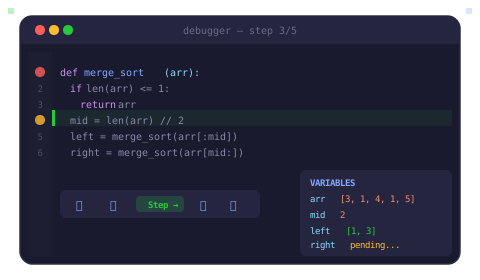
Modern, idiomatic C++ following the Core Guidelines. Smart pointers over raw new/delete, RAII for resources, const correctness, and effective STL usage. Valgrind output showing zero leaks. Compiled with -Wall -Wextra -Wpedantic, every warning addressed.
Our Process
Upload your code, paste instructions, and set your deadline.
We match you with a verified tutor who specializes in your language and topic.
Get a fully commented, pedagogical solution with Big-O analysis within 12 hours.
Common Academic Bottlenecks
Smart pointers, RAII, leaks, dangling pointers, and buffer overflows. We trace issues with Valgrind/ASan and provide ownership diagrams.
Choosing vector vs. deque vs. list, map vs. unordered_map — iterator invalidation, custom comparators, and lambda-based algorithms.
Cryptic error messages, SFINAE, type traits, and C++20 concepts. We decode template errors and explain instantiation step by step.
Virtual functions, vtable mechanics, diamond problem (virtual inheritance), Rule of Five, and slicing bugs.
University Courses
Linked lists, BSTs, AVL trees, heaps, hash tables with manual memory management and iterators.
Divide-and-conquer, dynamic programming, graph algorithms with STL and competitive optimizations.
fork/exec, pthreads, std::thread, synchronization, socket programming, and memory-mapped I/O.
OpenGL/Vulkan, shader programming, ray tracing, and physics simulation.
Segment trees, Fenwick trees, suffix arrays, network flow, and computational geometry.
Game loops, ECS, physics engines, memory pools, and real-time rendering.
Deep Dive
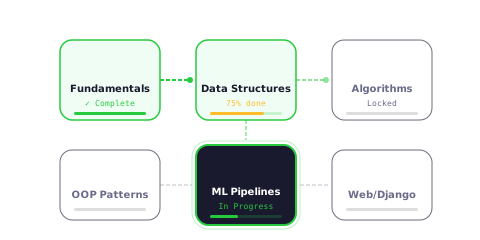
Rvalue references, std::move, compiler-generated move constructors, and std::forward for preserving value categories in templates.
SFINAE, variadic templates, constexpr, type traits, and C++20 concepts for zero-overhead abstractions.
Mutexes, condition variables, std::async, std::atomic, memory ordering, and lock-free patterns.
Arena, pool, and stack allocators for game engines and trading systems — fragmentation, alignment, and allocator-aware containers.
Portfolio
Template-based circular buffer or skip list with iterator support, allocator awareness, and Google Test coverage.
SQL-like queries with B-tree indexing, query parsing, and file-based record storage.
std::thread + epoll, thread pool, GET/POST handling, and connection management.
Phong shading, reflections, refractions, soft shadows, and anti-aliasing with OOP design.
Sample Output Quality
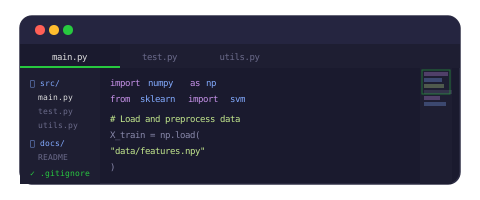
// RAII-safe resource management
#include <memory>

class ResourceManager {
    std::unique_ptr<int[]> buffer;
    size_t size;
public:
    explicit ResourceManager(size_t n)
        : buffer(std::make_unique<int[]>(n))
        , size(n) {}

    int& operator[](size_t i) { return buffer[i]; }
    size_t length() const { return size; }
    // No manual delete — RAII handles it
};
Why Us
Every solution is written from scratch with a Turnitin-compatible originality report.
Average delivery in 12 hours or less. Rush options available for urgent deadlines.
Every line is annotated with explanations, Big-O analysis, and learning notes.
Tutors hold CS degrees from accredited universities with 500+ problems solved.
Topic Coverage
310 Solutions
280 Solutions
240 Solutions
175 Solutions
260 Solutions
190 Solutions
130 Solutions
145 Solutions
85 Solutions
Testimonials
"Segfaults were killing me. The expert traced every memory issue with Valgrind and taught me RAII patterns. Lifesaver."
"Template metaprogramming finally clicked after reviewing their solution. The type trait examples were brilliant."
Pricing
Submit your assignment and get expert, pedagogical assistance within 12 hours. 100% Private & Confidential. Every solution includes line-by-line comments, Big-O analysis, and unlimited revisions.
Submit C++ AssignmentFAQ
Yes. GDB + Valgrind to trace dangling pointers, buffer overflows, and use-after-free. We teach debugging methodology with memory layout diagrams.
Yes — Codeforces, LeetCode, HackerRank. Segment trees, Fenwick trees, network flow, and implementation speed optimization.
unique_ptr, shared_ptr, weak_ptr — ownership semantics, move semantics, custom deleters, and reference counting internals.
Yes — target-based linking, find_package, cross-platform builds. Also Makefiles and Bazel.
Game loops, ECS, physics, OpenGL/Vulkan rendering, and memory optimization for real-time performance.
Yes — we decode cryptic messages, explain the compiler's intent, and teach static_assert/concepts for better diagnostics.
We interpret Memcheck/Massif/Callgrind output, identify leak sources, and explain definitely/indirectly/possibly lost categories.
Structured bindings, if constexpr, std::optional, std::variant, concepts, ranges, and coroutines.