1. Submit Your Assignment
Upload your code, paste instructions, and set your deadline.

Procedural / Systems Programming
Systems-level debugging, pointer mastery, and kernel-grade code quality. From malloc to mastery, delivered within 12 hours.
C is the foundational language of modern computing — Linux, Windows, macOS, embedded systems, and database engines are all written in C. Courses use it to teach memory layout, pointer arithmetic, system calls, process management, and hardware interaction. Unlike higher-level languages, C requires managing every byte of memory manually, making it simultaneously the most educational and most frustrating language for students.
Native Compilation (GCC, Clang)
Procedural / Systems Programming
No classes, no garbage collection, no built-in strings, no exception handling, no standard containers. Students implement everything from scratch — linked lists, hash tables, string functions, memory allocators — using pointers, structs, and manual malloc/free. Segmentation faults, buffer overflows, dangling pointers, and double frees are bugs that don't exist in garbage-collected languages. Undefined behavior means bugs produce different results on different compilers.
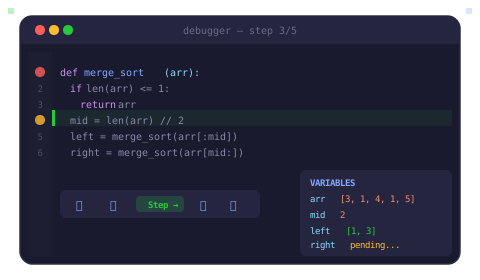
Clean, portable C compiled without warnings (-Wall -Wextra -Wpedantic). Defensive programming: NULL checks on every malloc, bounds checking on arrays. Every function documented with purpose, parameters, return value, and error conditions. Valgrind output showing zero leaks and zero errors. Memory diagrams for pointer relationships and stack frames.
Our Process
Upload your code, paste instructions, and set your deadline.
We match you with a verified tutor who specializes in your language and topic.
Get a fully commented, pedagogical solution with Big-O analysis within 12 hours.
Common Academic Bottlenecks
Double pointers, function pointers, array decay, buffer management. We draw memory diagrams showing where each pointer points and explain a[i] vs. *(a+i).
malloc/calloc/realloc/free patterns, leak detection with Valgrind, ownership semantics, and defensive programming against common errors.
High-level vs. low-level I/O, file descriptors, pipes, dup2, select/poll/epoll, and proper errno/perror error handling.
Linked lists, hash tables, trees, and graphs in C without classes or templates — clean APIs, proper memory management, and zero Valgrind errors.
University Courses
Variables, control structures, functions, arrays, strings (char arrays), pointers, and file I/O.
Linked lists, stacks, queues, BSTs, hash tables (chaining + open addressing) with manual memory management.
fork/exec/wait/pipe, signal handling, file descriptors, and inter-process communication.
Process scheduling, virtual memory (page tables, TLB), file systems (inodes), and synchronization.
TCP/UDP socket programming, HTTP implementation, DNS resolution, and packet parsing.
Bare-metal programming, registers, interrupts, I2C/SPI, and cross-compilation for ARM/AVR.
Deep Dive
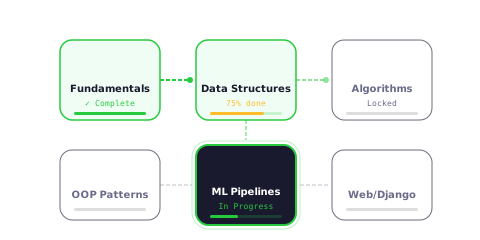
Custom malloc/free using sbrk() or mmap(). Free list management, splitting, coalescing, boundary tags, and buddy system strategies.
Building protocols from RFCs: byte ordering, serialization, state machines, timeout handling, and TCP-like reliability over UDP.
Kernel vs. user space, module init/cleanup, proc filesystem, ioctl handlers, spinlocks, and RCU.
Hand-written scanners, recursive descent parsing, AST construction, and type checking for subset languages.
Portfolio
Pipe chains, I/O redirection, background processes, signal handling, built-in commands, and job control.
Explicit free list, coalescing, best-fit strategy, and performance benchmarks against libc malloc.
Multi-threaded, GET/POST, static files, MIME types, persistent connections, and error responses.
Virtual disk with inodes, direct/indirect blocks, and free block bitmap supporting CRUD + mkdir.
Sample Output Quality
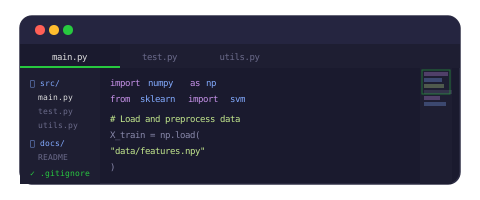
/* Generic linked list in C */
#include <stdlib.h>

typedef struct Node {
    void *data;
    struct Node *next;
} Node;

Node* list_prepend(Node *head, void *data) {
    Node *new_node = malloc(sizeof(Node));
    if (!new_node) return head;
    new_node->data = data;
    new_node->next = head;
    return new_node;
}

void list_free(Node *head) {
    while (head) {
        Node *tmp = head;
        head = head->next;
        free(tmp);
    }
}
Why Us
Every solution is written from scratch with a Turnitin-compatible originality report.
Average delivery in 12 hours or less. Rush options available for urgent deadlines.
Every line is annotated with explanations, Big-O analysis, and learning notes.
Tutors hold CS degrees from accredited universities with 500+ problems solved.
Topic Coverage
280 Solutions
220 Solutions
180 Solutions
140 Solutions
95 Solutions
110 Solutions
150 Solutions
65 Solutions
130 Solutions
Testimonials
"Socket programming in C felt impossible. The fully commented solution taught me more than 3 weeks of lectures."
"Custom memory allocator with free list — every pointer operation explained. Finally understand fragmentation."
Pricing
Submit your assignment and get expert, pedagogical assistance within 12 hours. 100% Private & Confidential. Every solution includes line-by-line comments, Big-O analysis, and unlimited revisions.
Submit C AssignmentFAQ
Yes. Process scheduling, virtual memory, file systems, synchronization primitives, and kernel modules.
Valgrind + AddressSanitizer to trace every allocation. We provide annotated reports and teach proper memory discipline.
Bare-metal programming, interrupt handlers, RTOS (FreeRTOS, Zephyr), I2C/SPI/UART, and ARM/AVR cross-compilation.
TCP/UDP clients and servers, connection management, protocol state machines, and select/poll/epoll for concurrent I/O.
Linked lists, hash tables, BSTs, heaps, and graphs — clean APIs, proper error handling, and zero Valgrind errors.
Proper dependency tracking, separate compilation, gcc -MMD, debug/release targets. Also CMake for larger projects.
Pipe chains, I/O redirection, signal handling, built-in commands, and job control using fork/exec/wait/pipe/dup2.
Portable code for Linux/macOS/Windows with conditional compilation (#ifdef) and abstraction layers.