1. Submit Your Assignment
Upload your code, paste instructions, and set your deadline.

Low-Level / Machine-Oriented
Register-level debugging, instruction set mastery, and CPU architecture tutoring. Bit by bit, delivered within 14 hours.
Assembly provides a one-to-one mapping between source code and CPU instructions. Courses in computer architecture, systems programming, and reverse engineering use it to teach ISAs, pipeline stages, memory hierarchy, and the hardware-software interface. Students encounter three major dialects: x86-64 (desktop/server), ARM (mobile/embedded), and MIPS (teaching ISA). Each has its own registers, addressing modes, and calling conventions.
Native CPU (x86, ARM, MIPS)
Low-Level / Machine-Oriented
No variables — only registers and memory addresses. No functions — only CALL/RET with manual stack frame construction. No if/else — only conditional jumps. Students must track register contents, stack pointer positions, and flag states through every instruction. Pipeline hazards require understanding instruction-level parallelism. No type safety means addressing mistakes cause silent data corruption.
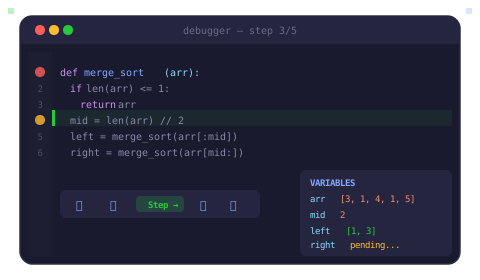
Every instruction annotated with its purpose, affected register contents, and high-level equivalent. Stack frame diagrams for every function. Pipeline timing diagrams with forwarding paths and stall cycles. Tested on target architecture simulators. Intel and AT&T syntax for x86, MARS/SPIM for MIPS.
Our Process
Upload your code, paste instructions, and set your deadline.
We match you with a verified tutor who specializes in your language and topic.
Get a fully commented, pedagogical solution with Big-O analysis within 12 hours.
Common Academic Bottlenecks
Addressing modes, sign extension (MOVZX/MOVSX), flags register — annotated examples building from simple to complex.
Pipeline hazards, branch delay slots, pseudo-instructions, and forwarding/stalling with 5-stage timing diagrams.
Stack frame construction — return address, callee-saved registers, local variables, calling conventions. Detailed memory diagrams at each instruction.
INT 0x80, SYSCALL, SWI — syscall numbers, argument registers, return values, and privilege transitions.
University Courses
Pipelining, hazard detection, forwarding, branch prediction, cache design, CPI calculation.
x86-64: MOV, LEA, arithmetic, control flow, stack operations, and system calls.
Calling conventions, stack frames, inline assembly, and compiler-generated assembly (gcc -S).
ARM register file, barrel shifter, conditional execution, Thumb instructions, and interrupts.
Binary analysis, disassembly, buffer overflow exploitation, ROP, and shellcode.
Superscalar, out-of-order (Tomasulo's), branch prediction, cache coherence (MESI), SIMD.
Deep Dive
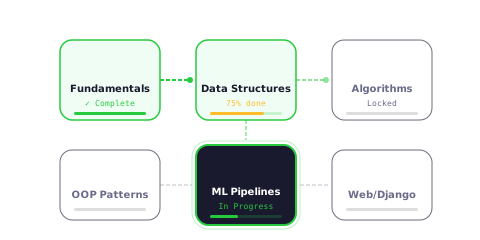
RAW/WAR/WAW data hazards, control hazards, forwarding paths, stall bubbles, and CPI calculation with timing diagrams.
Analyzing binaries without source: calling convention recognition, compiler pattern identification, and control flow reconstruction with objdump/GDB/radare2.
SSE, AVX, NEON for data parallelism — vector register usage, alignment, and 4–8x performance improvements in numerical computing.
System V AMD64 ABI and Microsoft x64 — argument registers, caller/callee-saved, stack alignment, red zone, with stack frame diagrams.
Portfolio
Proper stack frames, callee-saved register preservation, and pipeline analysis with cycle estimation.
strlen, strcmp, strcpy, strcat with null termination, boundary checking, and syscall I/O.
Bubble/insertion sort with conditional execution, barrel shifter, and memory-mapped output.
Integer arithmetic with string-to-int and int-to-string conversion routines.
Sample Output Quality
; x86-64 Fibonacci (NASM syntax)
section .text
global fibonacci

fibonacci:
    cmp rdi, 1
    jle .base
    push rbx
    mov rbx, rdi

    dec rdi
    call fibonacci       ; fib(n-1)
    push rax

    lea rdi, [rbx - 2]
    call fibonacci       ; fib(n-2)
    pop rbx
    add rax, rbx
    pop rbx
    ret
.base:
    mov rax, rdi
    ret
Why Us
Every solution is written from scratch with a Turnitin-compatible originality report.
Average delivery in 12 hours or less. Rush options available for urgent deadlines.
Every line is annotated with explanations, Big-O analysis, and learning notes.
Tutors hold CS degrees from accredited universities with 500+ problems solved.
Topic Coverage
140 Solutions
120 Solutions
80 Solutions
95 Solutions
60 Solutions
45 Solutions
75 Solutions
55 Solutions
30 Solutions
Testimonials
"MIPS pipeline hazards had me stuck for days. The tutor explained forwarding and stalling with timing diagrams."
"x86 calling conventions made zero sense until I saw this annotated solution. Stack frames are clear now."
Pricing
Submit your assignment and get expert, pedagogical assistance within 12 hours. 100% Private & Confidential. Every solution includes line-by-line comments, Big-O analysis, and unlimited revisions.
Submit Assembly AssignmentFAQ
Yes. MARS/SPIM debugging, 5-stage pipeline analysis, hazard identification, forwarding solutions, and annotated timing diagrams.
Both NASM (Intel) and GAS (AT&T). System V AMD64 ABI, proper stack frames, and GDB instruction-level debugging.
Binary analysis with objdump, GDB, radare2, and Ghidra. Control flow reconstruction and CTF challenges.
Timing diagrams, RAW/WAR/WAW identification, forwarding vs. stalling decisions, and CPI calculations.
Register file, barrel shifter, conditional execution, Thumb instructions, and bare-metal Cortex-M programming.
System V AMD64 and Microsoft x64 — argument registers, saved registers, alignment, red zone, with stack diagrams.
Hit/miss rates for direct-mapped, set-associative, and fully associative caches. Locality optimization and access pattern tuning.
RV32I base instruction set, standard extensions (M, A, F, D), and RISC-V simulators/GCC toolchain.